1859 Carrington Event
The Definition
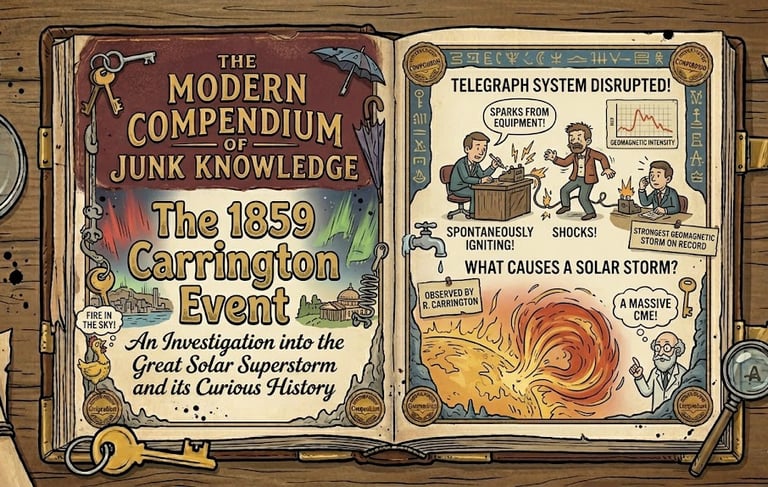
The most intense geomagnetic storm in recorded history. Triggered by a massive solar flare and coronal mass ejection (CME) that slammed into Earth’s magnetosphere, it caused brilliant auroras to be seen as far south as the Caribbean and induced powerful electrical currents in telegraph wires, causing them to spark, catch fire, and—in some cases—operate even after being disconnected from their batteries.
The Deep Dive
The "junk knowledge" behind the Carrington Event is that it marks the first time humanity realized the Sun could physically "touch" and break our technology. Before this, the Sun was seen as a constant, distant light. On the morning of September 1, 1859, British astronomer Richard Carrington was sketching sunspots when he witnessed a "white-light flare"—a sudden, blinding eruption on the Sun’s surface that lasted only five minutes.
The Speed of Light: Typically, it takes two to four days for a solar cloud to reach Earth. The Carrington CME was so powerful it made the journey in just 17.6 hours.
The Telegraph Ghost: The telegraph was the "internet" of the 1850's. During the storm, the induced current in the lines was so strong that operators in the U.S. and Europe found they could unplug their batteries and continue sending messages using only the "celestial electricity" flowing through the wires. Some operators received nasty electric shocks, and several telegraph stations reportedly burst into flames.
The Midnight Noon: The auroras were so bright that people in the Rocky Mountains woke up and began preparing breakfast, thinking the sun was rising. In the tropics, people were able to read newspapers by the light of the crimson and gold "northern lights" that filled the sky.
The Carrington Event reached peak "junk" status in the 21st century as a "doomsday" trope. It represents the "junk" of modern fragility: if an identical storm hit today, it wouldn't just burn out telegraphs; it would potentially fry the global power grid, melt satellite electronics, and knock out the internet for months, costing trillions of dollars in damage.
Fast Facts
The "Twin" Flare: Carrington wasn't the only one watching. Another astronomer, Richard Hodgson, observed the flare independently at the same time. While it’s named for Carrington, it was a dual discovery of the first solar flare ever recorded.
The Blood-Red Sky: Most auroras are green due to oxygen at lower altitudes. The Carrington auroras were described as a deep, terrifying "blood red," caused by solar particles interacting with oxygen at much higher altitudes than usual.
A Once-in-a-Century Event? Ice core samples suggest that "Carrington-class" events happen roughly every 500 years, though smaller but still dangerous storms happen much more frequently. In 2012, a solar storm of similar magnitude missed Earth’s orbit by only nine days.
References
Carrington, R. C. (1859). Description of a Singular Appearance seen in the Sun on September 1, 1859. Monthly Notices of the Royal Astronomical Society.
NASA. (2026). The Day the Sun Brought Darkness: Remembering 1859.
Phillips, T. (2014). Severe Space Weather Events—Understanding Economic and Societal Impacts. National Academies Press.