7-UP
The Definition
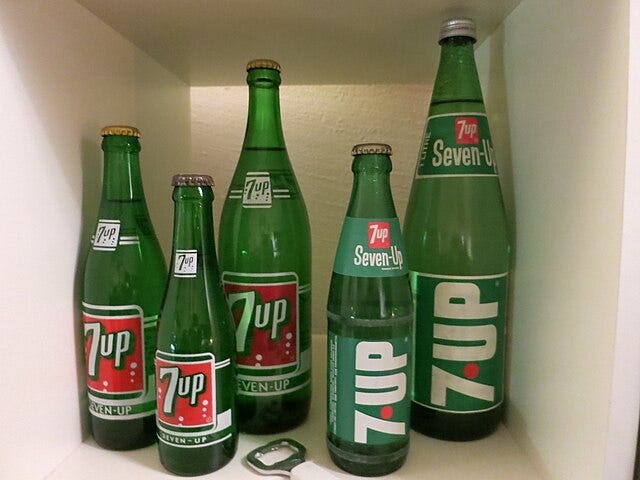
7-UP is one of the world's most iconic lemon-lime carbonated soft drinks. While celebrated today as a caffeine-free, crisp refreshment, the brand's name is shrouded in consumer folklore, hiding a gritty interwar history rooted in patent medicine and psychiatric pharmacology.
The Deep Dive
The bubbly, lighthearted branding of the modern beverage stands in stark contrast to its industrial origin story.
7-UP was formulated in St. Louis, Missouri, by entrepreneur Charles Leiper Grigg. He spent more than two years testing formulas before launching the beverage in October 1929—hitting the market a mere two weeks before the Wall Street crash that triggered the Great Depression.
Grigg did not launch the drink under a catchy name. It was introduced to the public as "7-Up Lithiated Lemon Soda." The word "Lithiated" was the absolute centerpiece of the product's identity because the original formulation contained lithium citrate, a powerful mood-stabilizing chemical compound.
In the early 20th century, "patent medicines" frequently blended active pharmaceuticals into carbonated water. Grigg aggressively marketed the soda's ability to clear hangovers, soothe frayed nerves, and lift the consumer’s spirits—a message that resonated deeply with an American public reeling from sudden economic ruin.
The medicine show ended in 1948. Following a federal regulatory crackdown on the unmonitored use of mood-stabilizers in consumer food products, the U.S. government officially banned lithium citrate from soft drinks. Grigg’s company stripped the chemical from the recipe, transforming 7-UP into a standard, sugary citrus refreshment by 1950.
Because Grigg died without leaving an official explanation for the name "7-UP," historians have advanced several compelling theories:
The Atomic Mass Theory: The most brilliant theory points straight to the periodic table. The atomic mass of the element Lithium is approximately 6.94, which rounds up perfectly to the integer 7. In this interpretation, the "7" represented the secret pharmaceutical anchor, and the "Up" referred to the drug's psychological ability to lift a depressed mood.
The Seven Ingredient Metric: This claim suggests the "7" simply represented the number of base ingredients in the original recipe: carbonated water, sugar, citric acid, sodium citrate, lithium citrate, and the essential natural oils of lemon and lime.
The Seven-Ounce Bottle: A pragmatic marketing theory focuses on early bottling logistics. While its chief competitor, Coca-Cola, was sold in small 6-ounce glass contours, Grigg packaged his beverage in a slightly larger 7-ounce bottle to give consumers a visible, high-value alternative at the soda fountain counter.
Fast Facts
The Acidic Reality: A persistent urban legend claims the drink was named "7-UP" because its formulation sits at a neutral pH level of 7. This is a scientific fiction; due to the heavy volume of citric acid, 7-UP has an acidic pH level floating around 3.8.
The "7 - 7" Legacy: Following the repeal of Prohibition, savvy marketers positioned the crisp soda as the ultimate mixer, birthing the legendary American bar order: the "7 - 7" (Seagram’s 7 Crown Whiskey and 7-UP).
References
Ammer, C. (2013). The Dictionary of Clichés. Skyhorse Publishing.
Oxford English Dictionary. (2026). The Lexical Codification of Proprietary Soft Drink Trademarks and Interwar Pharmaceutical Branding Alterations.