The Definition
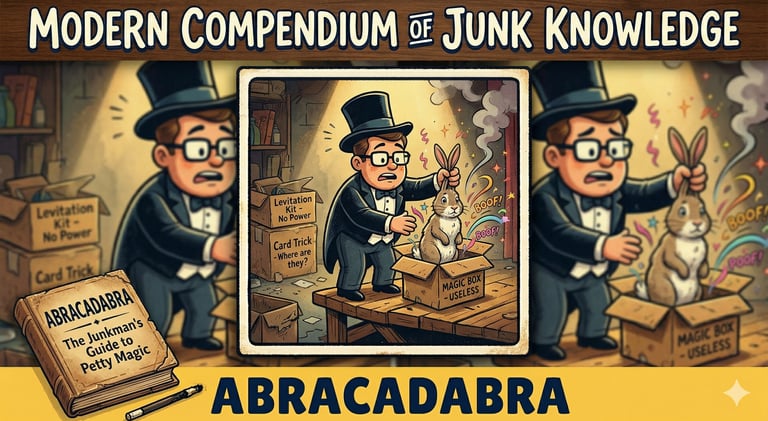
The most famous "magic word" in history. Once a powerful medical incantation used to ward off deadly diseases, it has survived the centuries to become a lighthearted staple of stage magic and children’s parties.
The Deep Dive
While we now associate "Abracadabra" with a rabbit pulled from a hat, its origins are rooted in the desperate superstitions of the Roman Empire. The word is not gibberish; it was a talismanic formula designed to "shrink" a fever or a plague until it vanished into nothingness.
The earliest recorded mention of the word appears in the 2nd-century work Liber Medicinalis by Quintus Serenus Sammonicus, the physician to the Roman Emperor Caracalla.
The Triangular Cure: To cure a patient of a persistent fever (likely malaria), Sammonicus instructed that the word "ABRACADABRA" be written on a piece of parchment in a descending triangle. Each line would drop the final letter of the previous line until only the letter "A" remained at the tip.
The Vanishing Act: The patient would wear this parchment around their neck as an amulet. The belief was that as the word "died" on the paper, the spirit of the disease would similarly lose its strength and eventually disappear from the victim's body.
The etymology of the word is a subject of intense "junk knowledge" debate. Some point to the Hebrew Ha-brakha-dabara ("The blessing has spoken") or the Aramaic Avra kehdabra ("I will create as I speak"). Others suggest it refers to Abraxas, a Gnostic deity often depicted with snakes for legs and a rooster's head, whose name possessed supreme numerological power.
Fast Facts
The "Great Plague" Revival: Even as late as the 17th century, during the Great Plague of London, desperate citizens were still wearing "Abracadabra" triangles around their necks to protect themselves from infection.
The Gnostic Connection: In Gnostic tradition, the letters of Abraxas add up to 365 in Greek numerology (Isopsephy), representing the days of the solar year and the "totality" of the universe.
The Modern Shift: The word transitioned from a serious medical "prescription" to a stage performer's flourish in the early 19th century, as the age of Enlightenment turned ancient magic into public entertainment,
References
Sammonicus, Q. S. (c. 200 AD). Liber Medicinalis.
Defoe, D. (1722). A Journal of the Plague Year. (Referencing the use of amulets).
Ammer, C. (2013). The Dictionary of Clichés. Skyhorse Publishing.
The Oxford English Dictionary. (2026). Abracadabra (n. and int.). Oxford University Press.