Ace in the Hole
The Definition
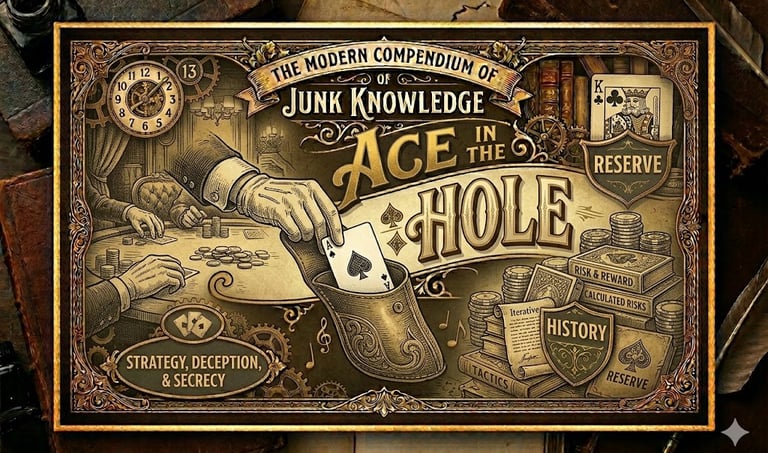
A hidden advantage or a secret resource held in reserve until the most critical moment. It describes a "trump card" that one’s opponent does not know exists.
The Deep Dive
While we now use this for a surprise witness in a trial or a secret feature in a new tech product, the "junk knowledge" behind this phrase is a literal, high-stakes moment in the American Old West. It is a direct reference to the mechanics of Stud Poker, specifically the five-card or seven-card variants.
In Stud Poker, unlike Draw Poker, most of a player's cards are dealt face-up for everyone at the table to see. However, the very first card is dealt face-down.
The "Hole" Card: This hidden card is known as the "hole card." A player peeks at it, but it remains a secret from the rest of the table until the final "showdown."
The Ace: If that face-down card is an Ace—the highest-ranking card in the deck—the player has an immense tactical advantage. They can see their opponent’s visible cards and calculate their bets knowing they have a hidden power that could win the entire pot.
The phrase moved from the smoke-filled saloons of the frontier into the general American vocabulary in the early 1900's. It was popularized by western novelists like Zane Grey and later by songwriters. By the time it appeared in the 1951 film Ace in the Hole (starring Kirk Douglas), the transition from the poker table to a metaphor for "secret leverage" was complete.
Fast Facts
The "Dead Man's Hand": In the same era of poker "junk," Aces and Eights (all black) became known as the "Dead Man's Hand," allegedly the cards Wild Bill Hickok was holding when he was shot in Deadwood in 1876.
The First Print: One of the earliest figurative uses appeared in a 1920's edition of the Chicago Tribune, referring to a political candidate's secret endorsement.
The Stud Variation: In "Seven-Card Stud," a player actually has three hole cards (two at the start and one at the end), but the "Ace in the hole" remains the singular, gold-standard metaphor for a winning secret.
References
Grey, Z. (1922). The Day of the Beast. (Early literary usage of gambling metaphors).
Parlett, D. (1991). The Oxford Guide to Card Games. Oxford University Press.
Ammer, C. (2013). The Dictionary of Clichés. Skyhorse Publishing.
The Oxford English Dictionary. (2026). Ace (n. and v.). Oxford University Press.