Acid Test
The Definition
A conclusive, definitive test that establishes the true value, quality, or authenticity of something. It is the "moment of truth" where a person’s character or a product’s durability is pushed to its ultimate limit to see if it holds up or "dissolves" under pressure.
The Deep Dive
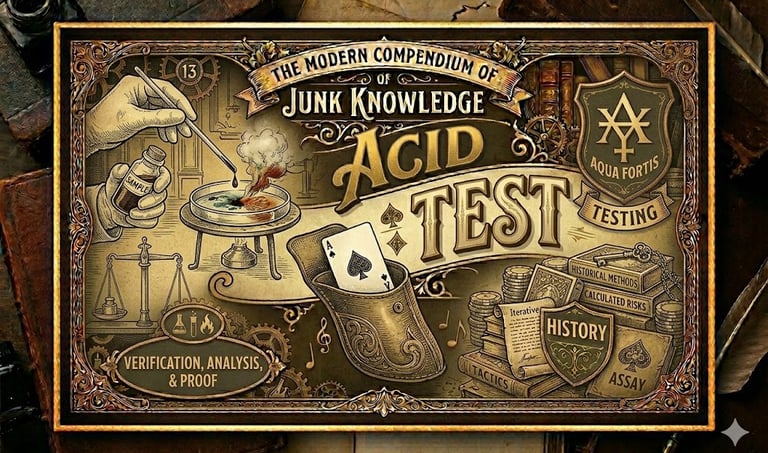
This is a "highly corrosive" piece of junk knowledge from the chaotic days of the California Gold Rush (1848–1855). Before the invention of portable spectrometers, prospectors and bankers needed a foolproof way to tell "fool's gold" (pyrite) from the real thing.
The Chemistry: Gold is a "noble metal," meaning it is remarkably resistant to corrosion and oxidation. Most common acids, like hydrochloric or sulfuric, have no effect on it.
The "Aqua Fortis" (Nitric Acid): To perform the test, a jeweler or banker would apply a drop of nitric acid to a suspect piece of metal.
If the metal was gold, it would remain unchanged.
If the metal was brass, copper, or pyrite, the acid would react instantly, creating a fizzing green or brown "burn" and dissolving the surface.
The phrase "acid test" entered the American lexicon as a metaphor for "truth" in the 1890's. It took a bizarre cultural turn in the 1960's when author Ken Kesey and his "Merry Pranksters" organized the "Acid Tests"—large-scale parties designed to test a person's psychological limits while under the influence of LSD (which was legal at the time). In these sessions, the "test" wasn't about the purity of the gold, but the "purity" of the mind's perception.
Fast Facts
The "Fool's Gold" Contrast: Iron pyrite (fool's gold) is very hard and brittle, whereas real gold is soft and malleable. While the acid test was the chemical proof, a "bite test" was often used as a physical check—if your teeth left a mark, it was likely gold.
The "LITMUS" Cousin: This is a linguistic relative. While an "acid test" is a final, high-stakes conclusion, a "litmus test" (using pH-sensitive paper) is a quick way to gauge a general trend or political lean.
The First Print: The phrase appeared in US newspapers like the Dakota Farmers' Leader in 1892 to describe a political candidate’s record being "put to the acid test."
References
Agricola, G. (1556). De Re Metallica. (The foundation of early mineral testing).
Wolfe, T. (1968). The Electric Kool-Aid Acid Test. (On the 1960's counter-culture shift).
Ammer, C. (2013). The Dictionary of Clichés. Skyhorse Publishing.
The Oxford English Dictionary. (2026). Acid (n. and adj.). Oxford University Press.