Acoustic Shadow
The Definition
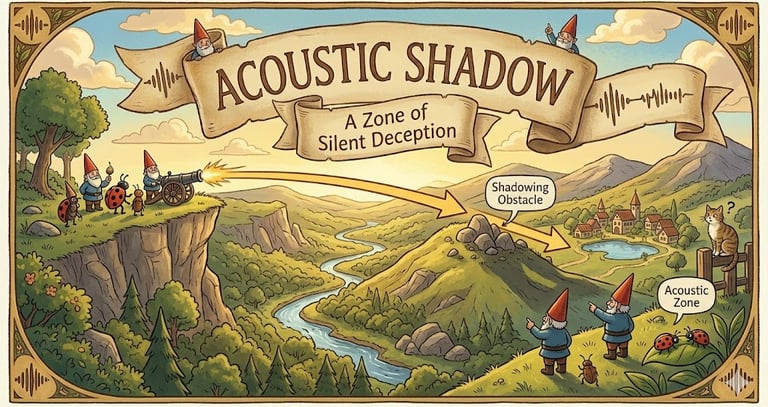
An acoustic shadow is an area where sound waves are blocked, deflected, or absorbed by a physical obstacle or atmospheric conditions, creating a zone of unnatural silence. Just as a physical object blocks light to cast a visual shadow, a hill, a structure, or a shift in air temperature can block audio waves, leaving an observer unable to hear a sound that is otherwise loud enough to travel for miles.
The Deep Dive
While the physics of acoustic shadows are rooted in basic wave mechanics, their historical significance is written in the blood of unexpected military disasters.
The Physics of Sound Deflection: Sound waves travel through the air by vibrating molecules. When these waves hit a large barrier—like a dense forest, a mountain ridge, or a heavy brick wall—they don't always pass through or bounce straight back. Instead, they can be absorbed or bent upward. If the air near the ground is cool and the air above is warm, the sound waves can actually refract (bend) upward into the sky, leaping completely over an observer on the ground and leaving them in a silent "shadow" zone.
The Silent Battles of the Civil War: The most famous historical manifestations of this phenomenon occurred during the American Civil War. During the Battle of Seven Pines (1862), Confederate General Joseph E. Johnston was stationed just a few miles from the front lines. Because of an acoustic shadow caused by atmospheric conditions and thick woods, he never heard the roaring cannon fire signaling the start of the battle, delaying his reinforcements and altering the course of the engagement.
The Gethsemane of Five Forks: A similar event occurred at the Battle of Five Forks (1865), where Confederate Generals George Pickett and Fitzhugh Lee were enjoying a shad bake just two miles away from their troops. An acoustic shadow completely muted the sounds of a massive Union assault. By the time the sound finally reached them, their lines had been broken, and the disaster effectively forced the retreat that led to the end of the war.
Modern Acoustic Landscapes: Today, the concept is actively engineered rather than suffered. Modern highway sound walls are calculated attempts to cast an artificial acoustic shadow over residential neighborhoods, bending and absorbing the "junk" noise of traffic to protect the peace of those living nearby.
Fast Facts
The "Gaines's Mill" Phenomenon: During the Battle of Gaines's Mill in 1862, people living over a hundred miles away in West Virginia could clearly hear the thunder of the cannons, while soldiers stationed just four miles away in the acoustic shadow heard absolutely nothing.
Sonic Booms: Modern supersonic aircraft can create temporary acoustic shadows ahead of their flight path because the plane is moving faster than the sound waves it generates, leaving a pocket of silence until the shockwave hits.
References
Ross, C. D. (2001). Civil War Acoustic Shadows. White Mane Publishing.
Tyndall, J. (1875). Sound: A Course of Eight Lectures. (Early scientific study on atmospheric acoustics).
Oxford English Dictionary. (2026). Wave Refraction and the History of Battlefield Acoustics.