All at Sea
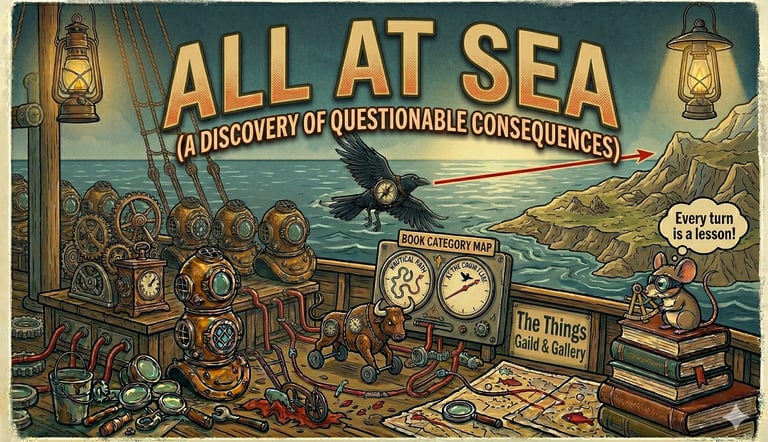
Definition
To be completely confused, disorganized, or unable to understand a situation. It describes a state of being "lost" even when one’s feet are firmly on dry land.
Deep Dive
Before the invention of the marine chronometer and the stabilization of GPS, being "at sea" was a literal state of profound uncertainty. While a captain could determine his latitude (how far north or south he was) by measuring the sun or stars, determining longitude (how far east or west) was nearly impossible for centuries.
If a ship lost sight of land and didn't have a precise way to calculate its position, it was truly "all at sea." Without a visible coastline or an accurate "dead reckoning," a crew had no idea where they were or how long it would take to reach safety.
The Precision of "All": The addition of the word "all" emphasizes the total lack of landmarks. To be "at sea" meant you were working; to be "all at sea" meant you were drifting without a clue.
The Transition: The phrase began appearing in a metaphorical sense in the early 19th century. It shifted from a terrifying reality for sailors to a common way for landlubbers to describe a mental fog or a chaotic project.
Interestingly, the British government was so concerned about ships being "all at sea" that they passed the Longitude Act of 1714, offering a massive prize to anyone who could solve the navigational puzzle.
Fast Facts
The Chronometer: John Harrison, a self-taught carpenter, eventually solved the "all at sea" problem by building a clock that could keep perfect time on a rocking ship.
The Horizon: On a clear day at sea, the horizon is only about 3 miles away from the deck of a standard ship, making it very easy to lose sight of land.
Literary Usage: Charles Dickens was a fan of the phrase, using it to describe characters who were hopelessly muddled in their thinking.
References
Dickens, C. (1850). David Copperfield. Bradbury & Evans.
Sobel, D. (1995). Longitude: The True Story of a Lone Genius Who Solved the Greatest Scientific Problem of His Time. Walker & Company.
Rogers, J. (1985). The Dictionary of Clichés. Facts on File Publications.
The Longitude Act. (1714). 13 Anne, c. 15. British Parliament.