All Is Gas
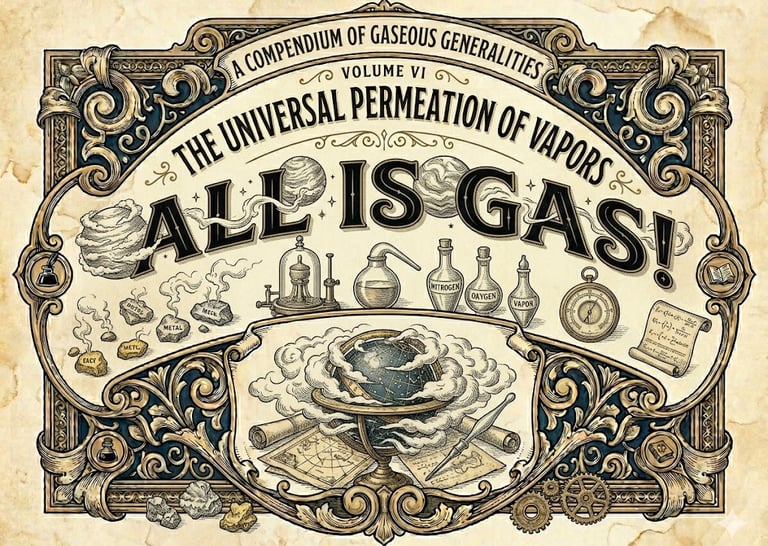
The Definition
"All is gas"—along with its structural cousins "everything is gas" or "it’s a gas"—is a phrase used across different eras to describe a state of complete satisfaction, chaotic amusement, or empty talk. The phrase relies on the physical properties of a gas: a substance that expands instantly and boundlessly to fill whatever space it is given, leaving no corner untouched.
The Deep Dive
The phrase has a fluid history, shifting from Victorian literature to 20th-century counterculture and modern psychology.
The Dickensian Satisfaction: The earliest ancestor of the phrase in English literature belongs to Charles Dickens. In his 1839 novel Nicholas Nickleby, the eccentric character Lord Frederick Verisopht exclaims that a pleasant situation is "gas and gaiters." At the time, gas lighting was a modern luxury and gaiters were fashionable legwear. To say "all is gas and gaiters" meant that everything was running smoothly, luxurious, and entirely satisfactory.
The Irish Wit: By the early 1900's, Irish vernacular pivoted the word "gas" away from luxury and toward comedy. In Irish slang, if a person or an event was described as "gas," it meant they were a source of immense fun, absurdity, or a good joke. In James Joyce's Dubliners (1914), characters routinely look to "have some gas"—using the concept of a volatile, floating substance to describe lighthearted mischief.
The Frankl Analogy: In a completely different context, the Austrian psychiatrist Viktor Frankl used the physics of gas as a profound psychological metaphor in his 1946 memoir Man’s Search for Meaning. Frankl wrote:
"To draw an analogy: a man's suffering is similar to the behavior of a gas. If a certain quantity of gas is pumped into an empty chamber, it will fill the chamber completely and evenly, no matter how big the chamber."
In this sense, "all is gas" describes how human emotion—whether grief, anxiety, or joy—can expand to consume a person's entire consciousness, regardless of the objective scale of the event.The Jazz and Rock Era: By the mid-20th century, the phrase mutated again through African American English and the global jazz scene. To say an experience was "a gas" (immortalized by James Baldwin in 1957 and later by The Rolling Stones in Jumping Jack Flash) meant it was an absolute thrill. It captured the feeling of an energy that, like an escaping vapor, was intense, intoxicating, and impossible to contain.
Fast Facts
The "All Gas, No Brakes" Evolution: In the 21st century, the metaphor shifted from the properties of the vapor to the accelerator pedal. The modern phrase "all gas, no brakes" denotes an unyielding, high-velocity effort with zero hesitation.
The Ancient Chaos: The word "gas" itself was invented in the 1600's by Flemish chemist J.B. van Helmont. He based it directly on the Greek word "chaos" (the empty, formless void that preceded the creation of the universe), mimicking the Dutch pronunciation.
References
Dickens, C. (1839). The Life and Adventures of Nicholas Nickleby. Chapman & Hall.
Frankl, V. E. (1946). Man’s Search for Meaning. Beacon Press.
Oxford English Dictionary. (2026). The Evolution of Volatile Metaphors in Slang and Literature.