And the Horse
You Rode In On
The Definition
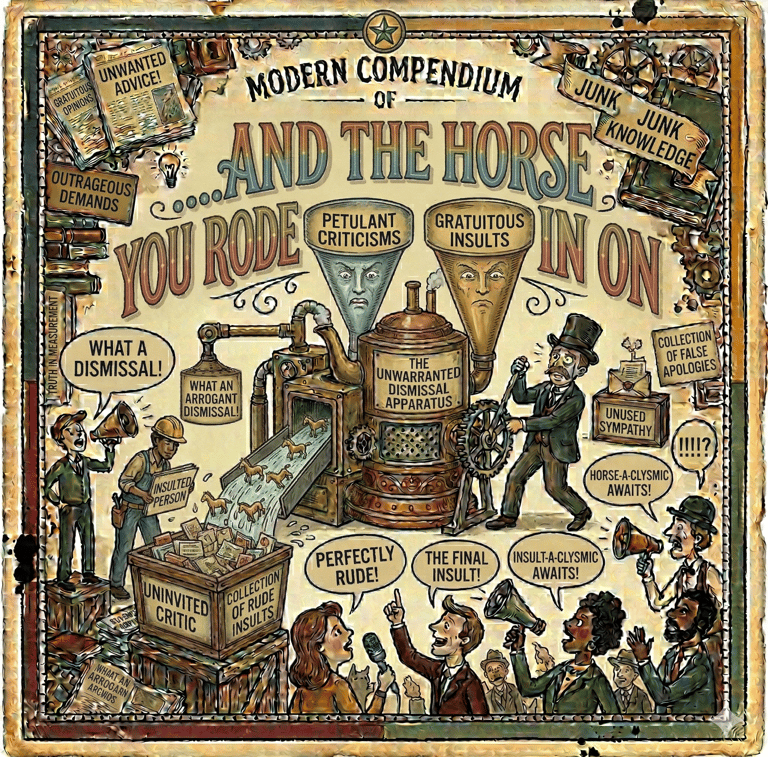
The ultimate "add-on" insult used to dismiss someone with total finality. It is typically the second half of the phrase "F*** you...", serving to extend the offense to everything the target represents, possesses, or relies upon. It suggests that the person is so unwelcome that even their mode of transportation is tainted by association.
The Deep Dive
The "junk knowledge" behind this phrase is its surprising connection to the American Western. While the words sound like they belong in a 19th-century saloon, the phrase didn't enter common usage until the mid-20th century. It is a linguistic evolution of the "cowboy" archetype, distilled through the lens of 1950's and 60's cynicism.
The Cowboy Insult: In the Old West, a man’s horse was his lifeline, his social status and his primary tool. To insult a man's horse was a grave offense, often viewed as a precursor to a physical fight. Adding "and the horse you rode in on" transformed a personal slight into a total rejection of the individual’s entire existence.
The Post-War Pivot: The phrase gained massive traction in urban America following World War II. It was famously used as a punchline in 1960's "dirty jokes" and became a favorite of New York City writers and comedians who enjoyed the juxtaposition of a rugged, rural insult in a modern, gritty city setting.
The idiom reached peak "junk" status in the 1970's and 80's, appearing in films and literature as the definitive "tough guy" exit line. It represents a specific type of American bravado—the idea that it isn't enough to simply tell someone to leave; you must also ensure they know that everything they brought with them is equally despised.
Fast Facts
The "Clean" Variant: In polite company or on broadcast television, the phrase is often shortened to just "And the horse you rode in on," with the initial profanity left as an unspoken "mad-lib" that the audience fills in for themselves.
The Literary Debut: One of the earliest recorded appearances in print was in the 1960's, notably in works reflecting the counterculture and the "New Hollywood" era of filmmaking.
The Reverse Usage: In some comedic circles, the phrase has been flipped as a sign of begrudging respect or "mock" hostility among close friends, emphasizing the absurdity of the equestrian reference in an age of cars and subways.
References
Safire, W. (1997). Watching My Language. Random House.
Ammer, C. (2013). The Dictionary of Clichés. Skyhorse Publishing.
Green, J. (2010). Green’s Dictionary of Slang. Cassell.
The Oxford English Dictionary. (2026). Horse (n.). Oxford University Press.