Angry Young Men
The Definition
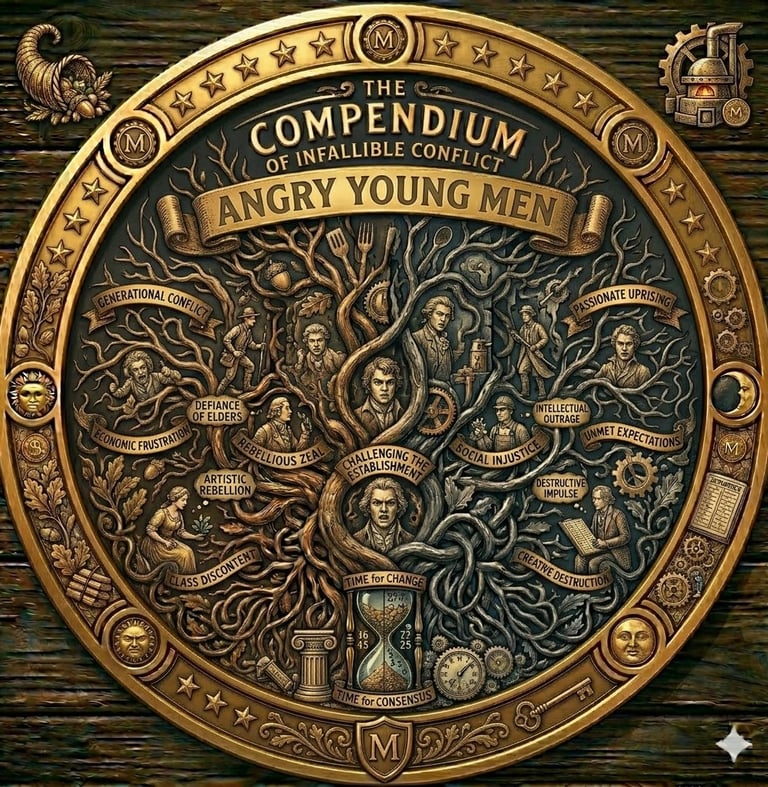
A catch-all term for a generation of British novelists and playwrights in the mid-1950's whose work expressed bitter disillusionment with traditional English society, the class system, and the "stiff upper lip" establishment. It has since evolved into a general idiom for any group of idealistic yet frustrated youth who feel "given the axe" by the status quo.
The Deep Dive
The "junk knowledge" behind the "Angry Young Men" is that they weren't actually a formal group or a "flock" with a shared manifesto. The label was a marketing masterstroke (and a bit of a "low blow") by a Royal Court Theatre press officer named George Fearon.
The Osborne Catalyst: In 1956, John Osborne premiered his play Look Back in Anger. The protagonist, Jimmy Porter, spent the entire show "sticking his nose in" the failures of the British Empire and shouting about the "junk" of middle-class morality. Fearon, looking for a way to sell tickets, told reporters he disliked the play and described Osborne as an "angry young man." The press loved it, and the name stuck to every writer who looked even slightly grumpy.
The "Kitchen Sink" Reality: These writers—including Kingsley Amis and Alan Sillitoe—popularized "Kitchen Sink Realism." They moved literature out of the aristocratic drawing rooms and into the equivalent of working-class flats. They focused on the "brass tacks" of life: bad housing, boring jobs, and the "load" of social climbing.
The Irony of Success: The "junk" twist of the movement was that the angrier they got, the more the establishment loved them. By railing against the "800-pound gorilla" of the British class system, they became wealthy celebrities, eventually "stepping into the boots" of the very elite they had mocked. Osborne eventually lived in a manor house, proving that sometimes, "what’s done is done" applies to rebellion too.
The phrase reached peak "junk" status in the late 1970's, when it was revived by music journalists to describe the first wave of Punk Rockers (like Elvis Costello and Joe Jackson). It represents the "junk" of cyclical frustration: every generation produces its own "angry young men" until they get old enough to "take a load off" and complain about the new generation.
Fast Facts
The Female Omission: Despite the name, there were "Angry Young Women" too (like Shelagh Delaney, author of A Taste of Honey), but the 1950's media "chickened out" of giving them equal billing in the "flock."
The Amis Paradox: Kingsley Amis, one of the original "Angry" authors, eventually became a staunch conservative and was knighted by the Queen—the ultimate "best of both worlds" transition from rebel to Sir.
The Billy Joel Link: In 1976, Billy Joel released "Prelude/Angry Young Man," a song that perfectly captured the "junk" of the persona: "He honors his mistakes as if they were triumphs / He's proud of the scars and the battles he's lost."
References
Osborne, J. (1956). Look Back in Anger. Faber and Faber.
Carpenter, H. (2002). The Angry Young Men: A Literary Comedy of the 1950's.
Taylor, J. R. (1963). Anger and After: A Guide to the New British Drama.