Apple-Polishing
The Definition
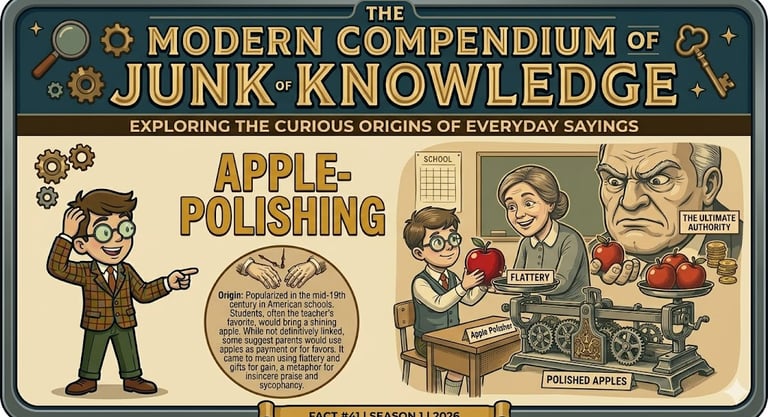
A colloquial idiom meaning to attempt to win favor or gain an advantage through sycophancy, flattery, or small, performative acts of kindness. It is essentially the classroom equivalent of "currying favor," where the "junk" of a shiny exterior is used to distract from a lack of substance or effort.
The Deep Dive
The "junk knowledge" behind "apple-polishing" is that it is a 20th-century Americanism that grew out of a literal tradition in the rural "one-room" schoolhouses of the 1800's.
The Teacher’s Tribute: In agricultural communities, fruit was often a form of currency. Families who couldn't afford to pay extra for their children’s education would send the child to school with a gift for the teacher—frequently a fresh apple from the family orchard.
The "Shine" of Sincerity: Originally, bringing an apple was a sincere gesture of gratitude toward an underpaid educator. However, by the early 1920's, the "flock" of students began to see it as a "low blow" to fair competition. If a student literally rubbed the apple against their sleeve to make it glow before placing it on the desk, they were "apple-polishing"—trying to use a visual "gimmick" to secure better grades or avoid "the axe" of a bad report card.
The "Junk" of Sycophancy: The phrase eventually migrated from the classroom to the corporate office. An "apple-polisher" became the "one-hit wonder" of the professional world—someone who is excellent at the "theatre" of being a good employee but struggles when it’s time to "get down to brass tacks."
The phrase reached peak "junk" status in the mid-20th century, often appearing in cartoons and comic strips as a shorthand for the "teacher's pet." It represents the "junk" of social manipulation: the hope that a small, shiny gesture can outweigh a "tall order" of actual work.
Fast Facts
The "Brown-Nosing" Connection: "Apple-polishing" is the "G-rated" version of more vulgar slang for flattery. It implies a certain innocence or childishness that other phrases lack.
The "Polished" Paradox: Interestingly, modern supermarkets use "waxing" to "polish" apples so they look better on the shelf. This is the literal, industrial version of the idiom—using a "junk" coating to make the product more appealing to the "flock" of shoppers.
The "Forbidden Fruit" Link: Some etymologists suggest the apple's role in the Garden of Eden adds a layer of "junk" irony to the phrase—using the symbol of "temptation" to get on the good side of an authority figure.
References
Ammer, C. (2013). The Dictionary of Clichés. Skyhorse Publishing.
Flexner, S. B. (1982). Listening to America. (On the evolution of schoolyard slang).
Oxford English Dictionary. (2026). The Commercialization of Academic Idioms.