Apples and Oranges
The Definition
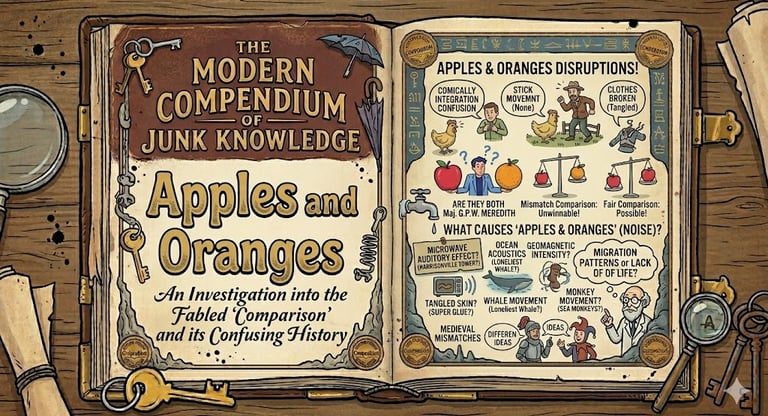
A popular idiom used to describe a comparison between two items that are inherently different, making any attempt to equate them logically flawed or "fruitless." It serves as the ultimate linguistic "stop sign" for false equivalencies.
The Deep Dive
The "junk knowledge" behind "apples and oranges" is that the world didn't always use these two specific fruits to describe a bad comparison. In fact, for centuries, the English-speaking world was much more concerned with Apples and Oysters.
The Shakespearean Swap: In the 1600's, the common phrase was "As like as an apple to an oyster." This made arguably more sense than the modern version: an apple is a firm, sweet fruit that grows on a tree, while an oyster is a salty, slimy mollusk that lives in the ocean. The contrast was absolute.
The 19th-Century Shift: As global trade made citrus more common in Europe and North America, the oyster was replaced by the orange. The first recorded use of "apples and oranges" in its modern sense appeared in 1889. The shift likely occurred because they are both round, common fruits found in the same bowl, making the temptation to compare them higher, even though their internal chemistry is completely different.
The Scientific Rebellion: In 1995, NASA scientist Scott Sandford decided to treat the idiom as a challenge. He conducted a study using infrared spectroscopy on a Red Delicious apple and a Navel orange. He published his findings in the journal Annals of Improbable Research, concluding that the two fruits are actually "remarkably similar" in their spectral defense, and that the "apples and oranges" defense is scientifically tenuous.
The phrase reached peak "junk" status in the late 20th century, becoming the favorite cliché of debaters and lawyers. It represents the "junk" of cognitive bias: our human tendency to group things by their superficial shape (round) rather than their fundamental substance (citrus vs. pome).
Fast Facts
The French Variation: In France, they don't compare apples and oranges; they compare apples and pears (comparer des pommes et des poires).
The Latin Root: The word "apple" used to be a generic term for almost any fruit. This is why the potato is "apple of the earth" (pomme de terre) and the tomato was once the "apple of gold" (pomodoro).
The Statistics Rule: In data science, "apples and oranges" is a formal warning against non-homogeneity. You cannot calculate the mean of a dataset if the units of measurement (e.g., miles vs. liters) are inconsistent.
References
Sandford, S. A. (1995). Apples and Oranges: A Comparison. Annals of Improbable Research.
Ammer, C. (2013). The Dictionary of Clichés. Skyhorse Publishing.
Oxford English Dictionary. (2026). History of Fruit Idioms.