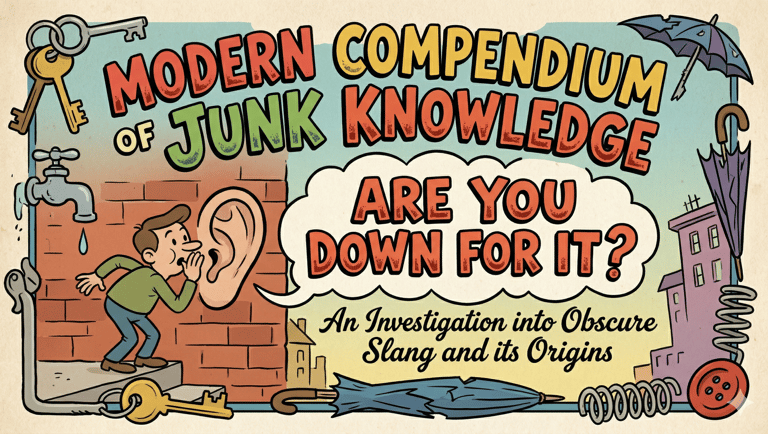
Are You Down for It?
The Definition
A casual inquiry asking if someone is interested in participating in an activity, agreeing to a plan, or joining a specific cause. It is the linguistic twin of "Are you up for it?", despite the two phrases using opposite directional prepositions to mean the exact same thing.
The Deep Dive
The "junk knowledge" mystery of this phrase is how "down" and "up" became synonyms in the world of informal agreement. In standard English, being "up" usually implies high energy or readiness, while being "down" implies a lower state or depression. However, in the evolution of American slang, "down" carved out a specific niche of solidarity.
The Ledger Logic: One theory suggests the phrase comes from the physical act of "writing one's name down" on a list or a sign-up sheet. To be "down for it" meant your name was physically recorded as a participant in a venture, a protest, or a party.
The "Down with the Cause" Origin: The phrase gained significant traction in 20th-century African American Vernacular English (AAVE) and jazz culture. Being "down" meant being "down with" a person or a movement—implying a deep, grounded level of commitment and understanding that went beyond a superficial "up" (ready) state.
The Directional Paradox: By the 1990's, the phrases "I'm down" and "I'm up for that" became completely interchangeable in youth culture. This creates a unique linguistic "glitch" where a person can be both "up" and "down" for the same pizza delivery at the same time without any confusion.
The phrase represents the "junk" of modern social navigation—a term that relies entirely on tone and context. If you are "down," you are cool, committed, and ready to go. If you are "down for the count," however, the direction regains its literal meaning of defeat, showing just how fickle prepositional slang can be.
Fast Facts
The "Down" vs. "Down with" Distinction: Being "down for" something usually refers to an activity (e.g., "down for a movie"), whereas being "down with" someone implies a social alliance or shared taste (e.g., "I'm down with that band").
The 1960's Pivot: The transition of "down" from a direction to a state of agreement was heavily influenced by the 1960's counterculture, where being "down" also meant being "hip" to a situation that others might miss.
The Binary Choice: In modern texting culture, "Down?" has become a complete sentence, functioning as a one-word invitation that requires only a "Yes," a "No," or a "👍" to finalize a plan.
References
Major, C. (1994). Juba to Jive: A Dictionary of African-American Slang. Penguin Books.
Ammer, C. (2013). The Dictionary of Clichés. Skyhorse Publishing.
Dalzell, T. (2008). The Routledge Dictionary of Modern American Slang and Unconventional English.
The Oxford English Dictionary. (2026). Down (adv.). Oxford University Press.