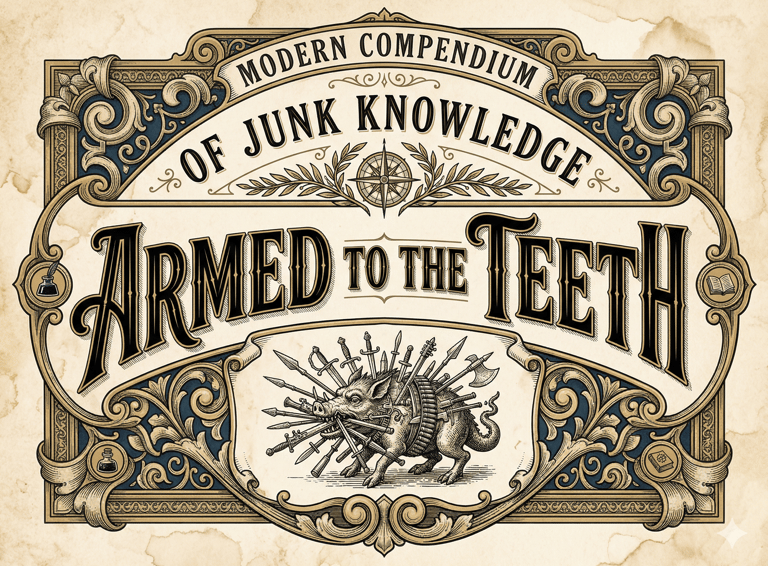
Armed to the Teeth
The Definition
To be extremely well-equipped with weapons or resources; carrying more gear than is strictly necessary. It implies a person is so bristling with armaments that they have run out of hands to hold them.
The Deep Dive
While many assume this phrase refers to a soldier having "grit" or "biting a bullet," the origin is far more literal and originated in the lawless waters of the 17th-century Caribbean. It describes the frantic, close-quarters combat of a pirate boarding party.
In the "Golden Age of Piracy," black-powder weapons like flintlock pistols and muskets were notoriously slow to reload. After a single shot, a pirate’s firearm became little more than a heavy club. To stay effective in the chaos of a ship-to-ship raid, a pirate needed to carry as many pre-loaded weapons as possible.
The Human Pack Mule: A well-prepared pirate would tuck several pistols into their belt, strap a cutlass to their side, and carry a boarding axe.
The Final Weapon: Once both hands were occupied by a sword and a pistol, the pirate would clench a long knife or a dagger between their teeth. This allowed them to climb the rigging or swing across to an enemy ship while still having a lethal backup weapon ready to be "dropped" into a hand the moment a pistol was fired and discarded.
To be "armed to the teeth" was a literal physical description of a person who had utilized every available part of their body to hold a weapon. By the 1840's, the phrase had moved into the general lexicon, popularized by adventure novelists who used it to describe anyone—from a lawyer with a mountain of evidence to a soldier with an excess of ammunition—who was prepared for a fight.
Fast Facts
The "Tooth" Knife: Pirates often used a dirk or a small stiletto for this purpose, as a full-sized cutlass was far too heavy for the jaw muscles to support.
The Risk: Carrying a knife in your teeth during a chaotic ship boarding was incredibly dangerous; a sudden jolt or a fall could result in a self-inflicted—and often fatal—throat or mouth injury.
Literary Appearance: One of the earliest modern uses appears in a 1849 edition of The Daily News, describing a politician as being "armed to the teeth" with arguments.
References
Cordingly, D. (1995). Under the Black Flag: The Romance and the Reality of Life Among the Pirates. Random House.
Exquemelin, A. O. (1678). The Buccaneers of America. (Eyewitness account of pirate tactics).
Ammer, C. (2013). The Dictionary of Clichés. Skyhorse Publishing.
Rogers, J. (1985). The Dictionary of Clichés. Facts on File Publications.