As the Crow Flies
The Definition
The shortest distance between two points, ignoring any obstacles, winding roads, or geographical detours. It represents a perfectly straight, mathematical line.
The Deep Dive
While the phrase seems like a simple observation of nature, its origin is a mix of ancient maritime tradition and 18th-century British road-mapping.
The "junk knowledge" myth often suggests that crows are unique in their ability to fly straight. In reality, crows (and most birds) actually meander, circle for thermals, or deviate to find food. However, the crow was singled out for this idiom for two primary reasons:
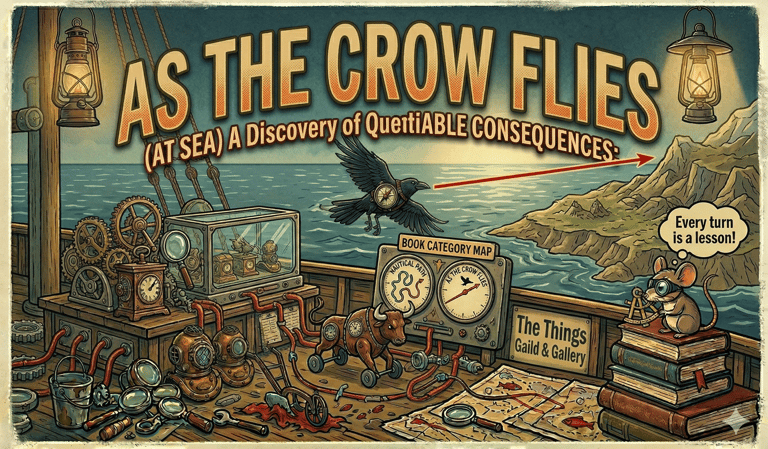
The Coastal Pilot: Before modern radar, British coastal vessels were said to carry a cage of crows or ravens. If a ship became lost in the fog or "all at sea," the captain would release a bird. Since the bird would instinctively fly toward the nearest land, the sailors would follow its path. The bird didn't follow the winding coastline; it flew the most direct route possible—"as the crow flies."
The Enclosure Acts: In the late 1700's, as British land was being surveyed and fenced off, "crow-flight" became a legal and cartographic term. It distinguished the actual distance across a field (the "straight-line" distance) from the much longer distance a person or carriage had to travel along public roads and around property boundaries.
The phrase was solidified in common English by the early 1800's, famously appearing in the works of Charles Dickens and in legal transcripts where travel distances were disputed.
Fast Facts
The Mathematical Counterpart: In modern geometry and navigation, this is known as the Great Circle Distance (the shortest path between two points on a sphere).
The Crow's Secret: Crows are actually highly intelligent and often "meander" more than other birds because they are constantly scanning for roadkill or shiny objects.
The Rival Phrase: In some parts of the American South and UK, the phrase "a bee-line" is used interchangeably, based on the belief that bees return to the hive in a perfectly straight line after foraging.
References
Dickens, C. (1838). Oliver Twist. Richard Bentley.
Macaulay, T. B. (1848). The History of England from the Accession of James II. Longman, Brown, Green, and Longmans.
Smyth, W. H. (1867). The Sailor's Word-Book. Blackie and Son.
Washington, G. (1753). The Journal of Major George Washington. (Referencing "straight-line" surveying).