At Odds
The Definition
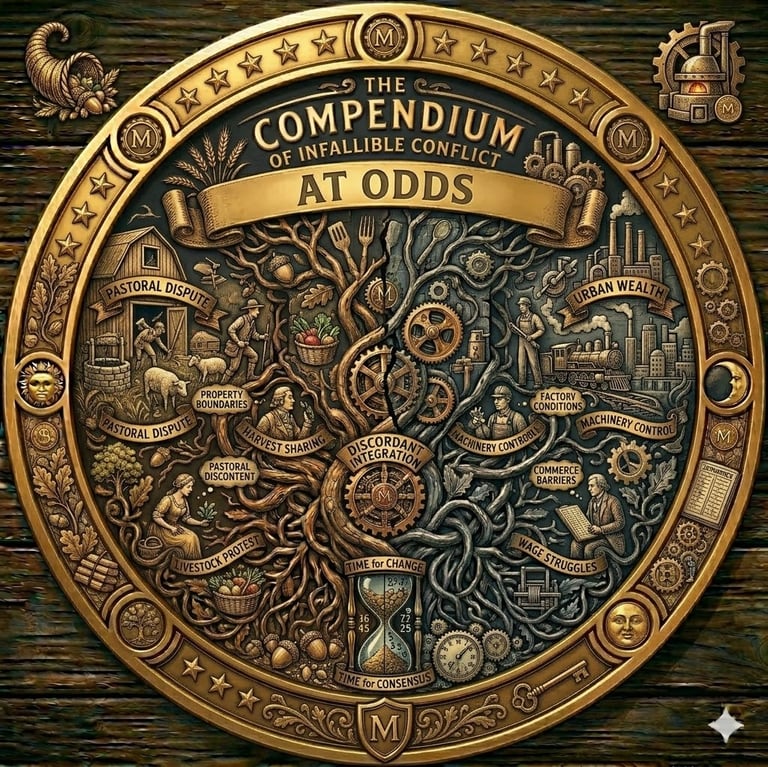
A common idiom used to describe a state of disagreement, conflict, or inconsistency between two or more parties, ideas, or sets of data. When people are "at odds," they are in opposition to one another—their "gears" aren't meshing, and they are definitely not "birds of a feather" at that moment.
The Deep Dive
The "junk knowledge" behind "at odds" is that it didn't start with a fight; it started with gambling and math. Before it was about two business partners "sticking their noses in" each other's territory, it was about the fundamental "junk" of probability.
The Betting Origin: In the 16th century, "odds" referred to the inequality between two stakes in a wager. If the chances weren't even (50/50), the numbers were "at odds." To be "at odds" was to be the "odd man out"—the remainder that doesn't fit into a clean, even pair.
The "Odd" vs. "Even" Tension: In English "junk" history, "even" numbers represented harmony and balance, while "odd" numbers represented instability and conflict. Being "at odds" meant you were the "extra" digit that prevented a situation from being "evened out."
The Shakespearean Boost: Shakespeare helped move the phrase from the betting table to the human heart. In Richard III, he wrote about being "at odds" with oneself, highlighting that the most difficult is often resolving the conflict inside your own mind.
The phrase reached peak "junk" status in the world of 20th-century diplomacy and technical analysis. It represents friction: the realization that for any "flock" to move forward, the members have to stop being "at odds" and start working together.
Fast Facts
The "Against the Odds" Cousin: While "at odds" is about conflict, "against the odds" is about overcoming probability. One is a struggle with someone; the other is a struggle against fate.
Stock Market Odds: In your technical analysis work, if the "analyst consensus" and the "price action" are at odds, it’s usually a signal that a market correction is coming.
The "Odd" Man Out: This related phrase refers to the person who is left over when everyone else has paired up—the literal remainder of a social equation.
References
Shakespeare, W. (1592). Richard III.
Ammer, C. (2013). The Dictionary of Clichés. Skyhorse Publishing.
Barnhart, R. K. (1988). The Barnhart Dictionary of Etymology.mar.