Attention Economy
The Definition
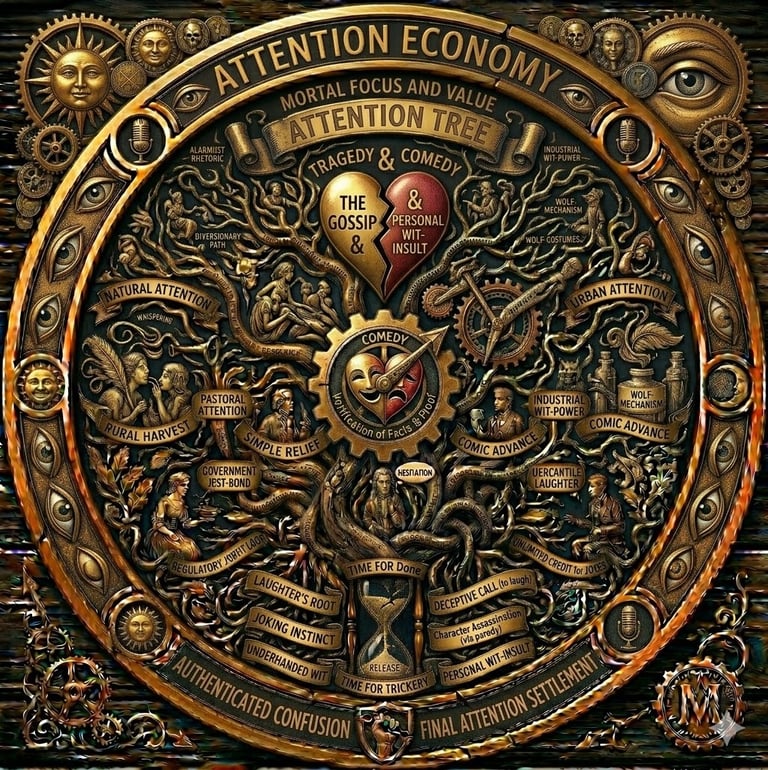
The attention economy is an approach to the management of information that treats human attention as a scarce, valuable, and tradable commodity. In an environment oversaturated with instant information, content is no longer the limiting factor; the bottleneck is our finite cognitive capacity to process it. Businesses, media entities, and technology platforms do not merely compete for our capital—they compete for our eyeballs, time, and mental bandwidth, treating human focus as the ultimate currency of the digital age.
The Deep Dive
While the phrase feels uniquely tethered to the smartphone era, its theoretical architecture was mapped out long before the first line of internet code was ever written.
The Simon Foundation: The concept was pioneered in 1971 by American psychologist, economist, and Nobel laureate Herbert A. Simon. Simon anticipated the coming digital age with startling accuracy, writing about the hidden cost of an information-rich world:
"What information consumes is rather obvious: it consumes the attention of its recipients. Hence a wealth of information creates a poverty of attention and a need to allocate that attention efficiently among the overabundance of information sources that might consume it."
The Goldhaber Expansion: In 1997, physicist and essayist Michael Goldhaber formally coined the term "Attention Economy" for the internet age. He warned that the international economy was undergoing a structural shift away from a material-based economy (centered on industrial manufacturing and physical commodities) and toward an attention-based economy. In this new landscape, those who control the systems that capture, hold, and direct human attention wield the true structural power.
The Weaponization of Engagement: With the advent of web 2.0 and social media, the attention economy was systematically codified into software engineering. Platforms realized that their corporate valuation was tied directly to metrics like "Daily Active Users" (DAU) and "Time on Site." To maximize these, tech companies hired behavioral psychologists and neuroscientists to design interfaces utilizing persuasive technology. Features like the infinite scroll, pull-to-refresh animations, and hyper-targeted algorithmic feeds were engineered to exploit the brain's natural dopamine loops, transforming human attention from a conscious choice into a conditioned reflex.
The "If It's Free..." Axiom: The rise of the attention economy completely redefined the relationship between businesses and consumers. Under standard capitalism, you pay money for a product. In the attention economy, the product (the app, the search engine, the social network) is free. This gave rise to the classic modern maxim: "If you aren't paying for the product, you are the product." Your attention is harvested, packaged, and auctioned off to advertisers in real-time bidding wars.
The Cost of Fragmentation
As platforms push to extract more "inventory" from our day, the attention economy has fundamentally altered human cognition and social structures.
Continuous Partial Attention: Coined by tech executive Linda Stone, this describes a state where individuals are constantly connected and scanning the horizon for new inputs—never completely present in any single task, leading to increased stress and decreased deep-thinking capabilities.
The Outrage Premium: Algorithms optimized purely for engagement quickly discovered that human beings look at divisive, shocking, or anger-inducing content far longer than they look at nuanced, calm information. Consequently, the attention economy structurally rewards hyper-partisanship and sensationalism, treating social outrage as an excellent retention tool.
Fast Facts
The Slot Machine Design: The "pull-to-refresh" gesture used on almost every smartphone app was explicitly designed by interface designer Loren Brichter to mimic the exact mechanics of a Las Vegas slot machine. The brief delay creates a variable reward schedule in the human brain—the anticipation of what might appear next keeps the user hooked.
The Sleep Competitor: In a famous 2017 corporate presentation, Netflix CEO Reed Hastings explicitly defined the terms of the attention economy by stating: "You know, think about it, when you watch a show from Netflix and you get addicted to it, you stay up late at night... We’re competing with sleep, on the margin."
References
Simon, H. A. (1971). Designing Organizations for an Information-Rich World. Johns Hopkins Press.
Goldhaber, M. H. (1997). The Attention Economy and the Net. First Monday.
Williams, J. (2018). Stand Out of Our Light: Freedom and Resistance in the Attention Economy. Cambridge University Press. (A masterful ethical critique by a former Google strategist).