Back to the Drawing Board
The Definition
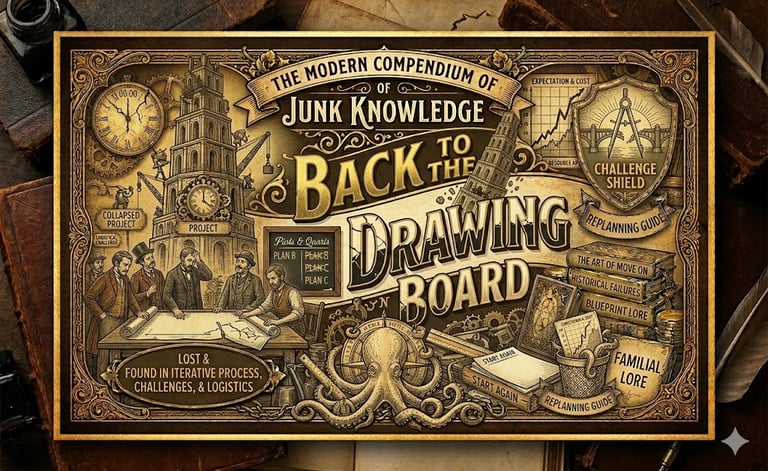
This idiom is used to indicate that a project, plan, or design has failed and that one must begin again from the very beginning. It implies a total abandonment of the current iteration in favor of a fresh start, often after a significant "wrench in the works" has rendered the previous effort useless.
The Deep Dive
Unlike many ancient proverbs, this phrase has a specific, traceable origin in 20th-century American popular culture, specifically within the world of engineering and wartime production.
The New Yorker Cartoon: The phrase was coined by artist Peter Arno in a cartoon published in The New Yorker in 1941. The illustration depicts a group of military officers and engineers standing on a tarmac, looking at a crashed experimental aircraft in the background. In the foreground, a man carrying a roll of blueprints walks away calmly, saying, "Well, back to the old drawing board."
Engineering Reality: Before the advent of computer-aided design (CAD), engineers and architects literally worked at large, slanted tables known as drawing boards. To go "back to the drawing board" meant returning to the drafting room to create an entirely new set of technical specifications. It was a literal retreat to the conceptual phase of a project.
Wartime Adoption: The phrase gained immense popularity during World War II, a period defined by rapid technological innovation and frequent failures. It became a tall order of resilience, serving as a shorthand for the perseverance required to perfect complex machinery under intense pressure.
Fast Facts
The "Square One" Rival: While "back to square one" (likely originating from board games or radio football commentary) suggests a return to the start, "back to the drawing board" specifically emphasizes the redesign and creative labor involved in a fresh attempt.
Professional Resilience: In modern innovation cycles, the phrase is often associated with "failing fast"—the idea that identifying a flaw early and returning to the drawing board is more efficient than pursuing a broken concept.
References
Arno, P. (1941, March 1). The New Yorker. (Cartoon).
Ammer, C. (2013). The Dictionary of Clichés. Skyhorse Publishing.
Oxford English Dictionary. (2026). The Impact of 20th-Century Periodicals on Idiomatic English.