Baghdad Battery
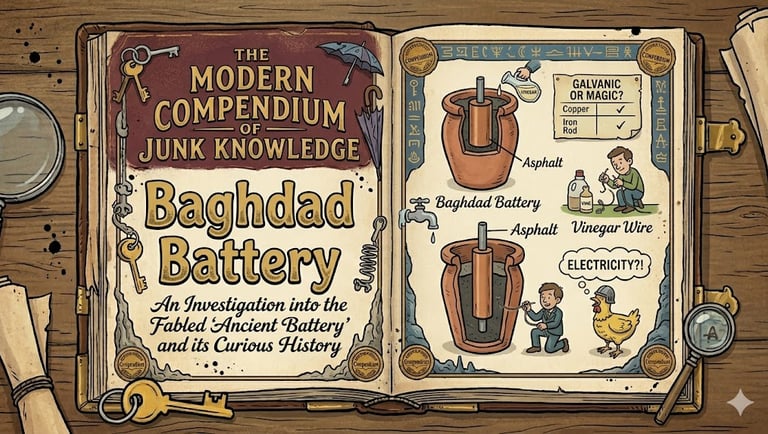

The Definition
A set of three artifacts—a ceramic pot, a copper tube, and an iron rod—found in Khujut Rabu, Iraq, dating back to the Parthian (c. 250 BCE – 225 CE) or Sassanid (c. 224–650 CE) periods. Since their discovery in 1936, they have been the subject of intense debate as a potential candidate for the world's oldest electric battery.
The Deep Dive
The "junk knowledge" behind the Baghdad Battery is that while it could have produced an electric current, there is no historical evidence that ancient Mesopotamians actually used it for power. It is a masterpiece of archaeological "what-if" scenarios.
The Anatomy of a Cell: The device consists of a 5-inch-high clay jar containing a hollow copper cylinder. Inside the cylinder is a single iron rod. If the jar were filled with an acidic liquid—such as vinegar, lemon juice, or fermented grape juice (wine)—the chemical reaction between the copper and iron would create a small electrical potential.
The König Hypothesis: Wilhelm König, the German director of the National Museum of Iraq who found the objects, was the first to suggest they were galvanic cells. In the 1940's, researchers built replicas and successfully generated between 0.5 and 1.1 volts.
The Electroplating Theory: The most popular theory for its use is "gilding" or electroplating. By using a series of these batteries, ancient craftsmen could have theoretically deposited a thin layer of gold or silver onto jewelry or statues. However, most gilded artifacts from that era show evidence of "mercury gilding," a fire-based process that doesn't require electricity.
The Baghdad Battery reached peak "junk" status in the early 2000's, famously appearing on the show MythBusters, where the team proved it could produce a current but noted the total lack of wiring or conductive cables found at the site. It represents the "junk" of historical speculation: a device that looks exactly like a modern battery but may have simply been a specialized container for holding sacred scrolls or papyrus, with the copper and iron serving as a protective seal.
Fast Facts
The Missing Link: The biggest argument against the "battery" theory is the complete absence of any electrical accessories. To be useful, the battery would need wires, conductors, or devices to power, none of which have been found in the Mesopotamian archaeological record.
The Acid Proof: Tests on the original artifacts revealed traces of acidic residue inside the jars, which supports the idea that they once held a liquid like wine or vinegar—though these were also common preservatives.
The Lost Artifact: Tragically, the original Baghdad Battery was among the thousands of artifacts looted or lost from the National Museum of Iraq during the 2003 invasion, meaning modern scientists can no longer perform high-tech non-invasive testing on the original materials.
References
König, W. (1938). Ein Galvanisches Element aus der Partherzeit? (A Galvanic Element from the Parthian Period?).
Al-Haik, A. R. (1964). The Baghdad Battery.
The Discovery Channel. (2005). MythBusters: Episode 29 - Baghdad Battery.