Bail Out
The Definition
To escape a difficult, failing, or dangerous situation. It can refer to an emergency exit from a vehicle (like a plane) or a financial rescue (like a government intervention).
The Deep Dive
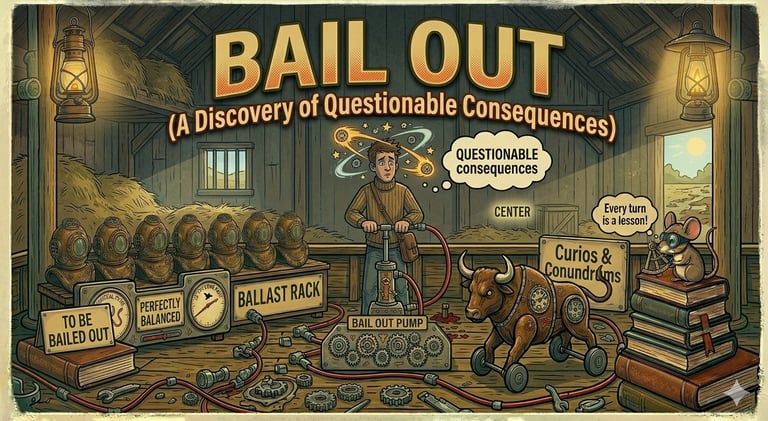
The phrase is a "linguistic stowaway" that traveled from the bottom of a boat to the cockpit of a fighter jet. While we now use it to describe everything from a bad date to a multi-billion dollar banking crisis, its origins are divided between two very different mechanical actions:
The Bucket (Maritime): The earliest sense comes from the Old French baille, meaning "bucket." When a boat takes on water, the crew must "bail it out" to keep the vessel afloat. This is a desperate, manual labor process of moving liquid from the inside to the outside. In this context, to "bail out" is to save the ship by removing the problem.
The Pilot (Aeronautical): By the early 1920's, the term took on a new, more personal meaning. When a pilot’s aircraft was doomed, they would "bail out"—literally throwing themselves out of the cockpit. Interestingly, some etymologists suggest this was influenced by the "bucket" concept (ejecting oneself like water from a boat), while others point to the term "bail" as a hoop or handle (the release mechanism for early parachutes).
The financial "bailout" is a hybrid of these two. It suggests that a company or economy is "taking on water" and requires a massive infusion of outside help (the bucket) to keep from sinking, often allowing the leadership to "parachute" to safety.
Fast Facts
The Spelling: In the UK and Australia, the maritime version is often spelled "bale out," though "bail" has become the global standard for the aeronautical and financial meanings.
The "Golden Parachute": This modern corporate term is a direct evolution of the "bail out" metaphor, describing a soft landing for executives exiting a failing company.
The First Bailout: The first recorded use of "bail out" in a parachute context appeared in 1925 in the Aeroplane journal, describing a pilot who had to "abandon ship."
References
Bernstein, P. L. (1996). Against the Gods: The Remarkable Story of Risk. John Wiley & Sons.
Oxford English Dictionary. (2026). Bail (v.2) and Bail (v.3). Oxford University Press.
Smyth, W. H. (1867). The Sailor's Word-Book. Blackie and Son.
Zimmer, B. (2010). "The Origins of the 'Bailout'." The New York Times Magazine.