Baker’s Dozen
The Definition
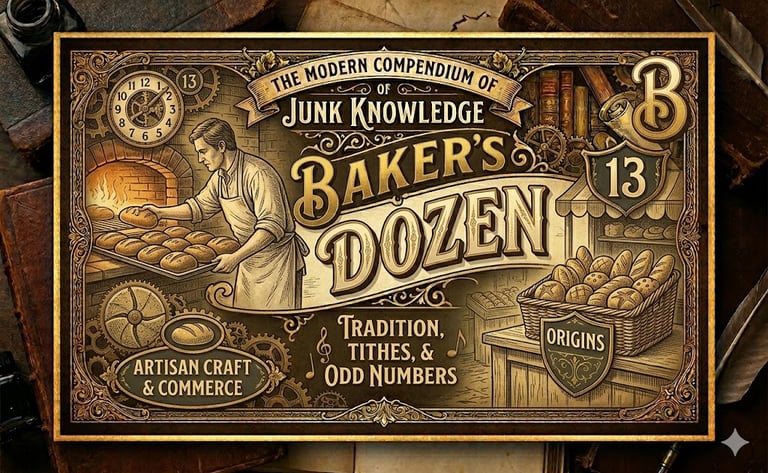
A set of thirteen items instead of the standard twelve. It describes a generous "over-count," typically given to ensure that a customer receives at least the minimum amount promised.
The Deep Dive
This is a classic piece of "junk knowledge" born from the fear of the medieval courtroom. In 13th-century England, King Henry III enacted the Assize of Bread and Ale, a strict law that regulated the weight, quality, and price of bread based on the current cost of wheat.
For a medieval baker, the "Assize" was a terrifying piece of legislation.
The Heavy Hand of the Law: If a baker sold a loaf of bread that was found to be underweight—even by a tiny fraction—they faced severe penalties. These included heavy fines, the loss of their business license, or being "drawn on a hurdle" through the streets with the underweight loaf tied around their neck while being pelted with filth.
The "In-Case" Loaf: Because bread can lose weight during baking due to evaporation, and because medieval scales were notoriously imprecise, bakers lived in constant anxiety. To protect themselves from accidental "short-weighting," they would add an extra loaf to every order of twelve.
By providing thirteen loaves for the price of twelve, the baker ensured that the total weight of the batch would always exceed the legal requirement, even if one or two individual loaves were slightly "light." This thirteen-count became known as the "Vantage Loaf" or the "In-Bread," eventually settling into the common idiom "Baker's Dozen."
Fast Facts
The "Devil's Dozen": In some European cultures, thirteen is known as the "Devil's Dozen" (due to its association with the Last Supper or witches' covens), but for the English baker, it was a lucky number that kept them out of the stocks.
The First Print: The term "Baker's Dozen" first appeared in English literature in the late 1500's, by which time the "Assize" had been the law of the land for over 300 years.
The "Thirteen" Standard: While the law was eventually repealed in the 19th century, the tradition of the thirteen-item "dozen" survived in specialty bakeries and bagel shops as a sign of old-world hospitality.
References
Statutes of the Realm. (1266). Assisa Panis et Cervisiae (Assize of Bread and Ale).
Grose, F. (1785). A Classical Dictionary of the Vulgar Tongue. S. Hooper.
Ammer, C. (2013). The Dictionary of Clichés. Skyhorse Publishing.
The Oxford English Dictionary. (2026). Baker (n.1) and Dozen (n. and adj.). Oxford University Press.