The Definition
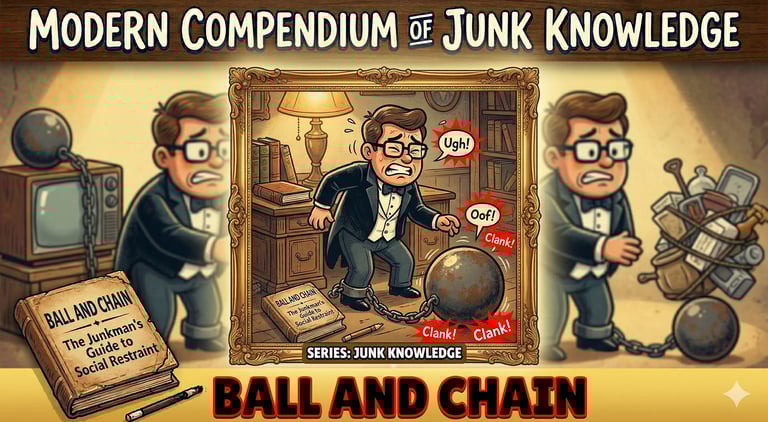
A heavy burden or a situation that severely limits one's freedom. Most commonly, it is used as a slang (and often derogatory) term for a spouse, implying that marriage is a form of life sentence or physical captivity.
The Deep Dive
While the "junk knowledge" usage is often a punchline in mid-century sitcoms, the origin is a grim piece of 19th-century British and American prison engineering. Before the era of high-tech surveillance and electrified fences, the "ball and chain" was the standard method for preventing escapes from "chain gangs" and outdoor labor camps.
The device consisted of a heavy iron sphere (the ball) connected by a short length of chain to a shackle around the prisoner's ankle.
The Physics of Prevention: The ball was typically made of solid cast iron and weighed between 15 and 40 pounds. While a prisoner could walk (with a distinctive, labored hobble), they could not run or climb without physically picking up the weight. This made a sudden dash for freedom impossible and exhausted the prisoner over the course of a day's labor.
The "Lifer" Association: In British penal colonies like Australia, the ball and chain was reserved for "secondary offenders"—prisoners who had committed further crimes while already incarcerated. It became a visual symbol of a "permanent" or "inescapable" state of being.
The transition from a literal prison tool to a marital metaphor occurred in the late 19th century. By the 1880's, humorists began using the term to describe the "weight" of domestic responsibilities. It suggests that once "shackled" by a wedding ring, a person's days of free-roaming and "running" are over.
Fast Facts
The "Iron Pile": In some prisons, if a man was considered a high escape risk, he was forced to carry two balls—one on each leg—effectively pinning him to his spot.
The "Weight" of Law: The standard British "convict ball" was exactly 24 pounds, a weight determined to be the maximum a man could move but the minimum required to stop him from sprinting.
Pop Culture Peak: The phrase was immortalized in 20th-century cartoons (like The Flintstones or Looney Tunes), where characters are frequently seen dragging oversized, comic-book versions of the device.
References
Hughes, R. (1986). The Fatal Shore: The Epic of Australia's Founding. Knopf.
Grose, F. (1811 edition). Dictionary of the Vulgar Tongue. (Referencing early penal slang).
Ammer, C. (2013). The Dictionary of Clichés. Skyhorse Publishing.
The Oxford English Dictionary. (2026). Ball (n.1) and Chain (n.). Oxford University Press.ss.ity Press.