Barking Mad
The Definition
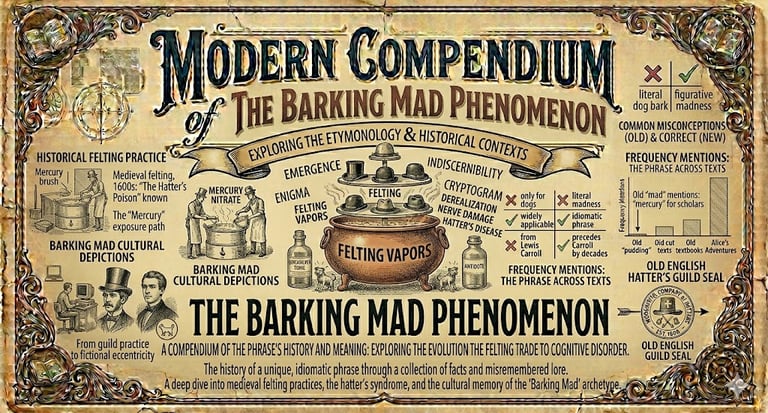
A colloquial British idiom used to describe someone who is completely insane, eccentric, or behaving in an irrational and frantic manner. It suggests a level of lunacy so extreme that the person has lost the power of human speech and has resorted to the senseless, repetitive noise of a dog.
The Deep Dive
The "junk knowledge" behind "barking mad" is a tale of two theories: one involving a literal neighborhood in London and the other involving the "junk" science of medieval medicine.
The "Barking" Asylum Theory: Many believe the phrase refers to the London suburb of Barking, which was home to a famous nunnery (Barking Abbey). According to local lore, the abbey or a nearby hospital housed those who had "lost their wits." However, most etymologists think this is "junk" folk etymology—a coincidence of naming rather than the true source.
The Rabies Connection: The more likely origin is the terrifying reality of rabies (hydrophobia). In the centuries before vaccines, a person bitten by a rabid animal would eventually succumb to a disease that caused foaming at the mouth, intense agitation, and involuntary "barking" sounds caused by throat spasms. To be "barking mad" was to be in the final, frantic stages of a literal death sentence.
The "Baying at the Moon" Link: It is a sibling to the word "lunatic," which comes from the Latin luna (moon). The idea was that the insane were influenced by the moon’s cycles, much like dogs or wolves that "bark" or howl at the night sky.
The phrase reached peak "junk" status in the late 20th century, largely thanks to British comedy and tabloids. It represents the "junk" of exaggeration: moving from a literal medical horror to a casual way to describe a neighbor who decides to paint their house neon purple.
Fast Facts
The "Stark Raving Mad" Rival: While "barking mad" implies noise and animalistic behavior, "stark raving mad" focuses on the "raving" (unintelligible talk). "Stark" in this context comes from "stark naked," implying the madness is "uncovered" and total.
The 1930's Surge: Although the concepts are old, the specific pairing of the words "barking" and "mad" didn't become a "license to print money" for writers until the early 20th century, specifically in British sporting and military circles.
The "Gone to the Dogs" Connection: This related idiom describes a situation that has fallen apart or become "junk." If a person has "gone to the dogs," they are often just a "close shave" away from being "barking mad."
References
Ammer, C. (2013). The Dictionary of Clichés. Skyhorse Publishing.
Ayto, J. (1990). Dictionary of Word Origins. Arcade Publishing.
The Wellcome Collection. (2026). A History of Hydrophobia in the British Isles.