Barking Up the Wrong Tree
The Definition
To follow a false lead or pursue a mistaken line of thought. It describes a situation where someone is putting a great deal of energy into a solution or an accusation that is fundamentally incorrect.
The Deep Dive
This quintessentially American idiom is a "gift" from the frontier life of the early 1800's. While modern city dwellers might think of it as a generic metaphor for a confused dog, it actually refers to the highly specialized skill of raccoon hunting.
Raccoons are nocturnal, incredibly agile, and famous for their ability to "double back" or leap from the branches of one tree to another—a move hunters call "tapping" a tree.
The Treeing Dog: In a standard hunt, a hound (often a Bluetick or Coonhound) tracks the scent of a raccoon until the animal retreats up a trunk. The dog then stands at the base, baying and "barking" to alert the hunter that the prey is trapped.
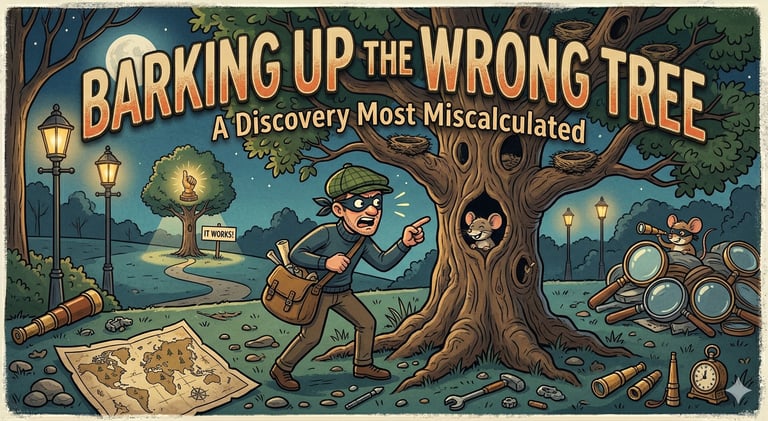
The "Wrong" Tree: A clever raccoon will climb up one tree, crawl across a high-reaching limb into a neighboring tree, and descend quietly while the dog is still focused on the first trunk. The hound, relying on the lingering scent at the base, continues to bark frantically at an empty tree.
By the time the hunter arrives with a lantern, the dog is literally "barking up the wrong tree." The dog is working hard and showing great passion, but its target is long gone. The phrase moved from the woods of Kentucky and Ohio into the national vocabulary during the 1830's, popularized by legendary frontiersmen like Davy Crockett.
Fast Facts
The "Tap" Maneuver: Raccoons are one of the few mammals that can rotate their hind feet 180 degrees, allowing them to descend trees head-first, which helps them "escape the bark" more efficiently.
First Recorded Use: The phrase appeared in James Kirke Paulding’s Westward Ho! in 1832: "He’s been barking up the wrong tree, I reckon."
Political Pedigree: Davy Crockett used the phrase in his 1834 autobiography to describe his political opponents' misguided attacks on his character.
References
Crockett, D. (1834). A Narrative of the Life of David Crockett, of the State of Tennessee. E.L. Carey and A. Hart.
Paulding, J. K. (1832). Westward Ho!. J. & J. Harper.
Ammer, C. (2013). The Dictionary of Clichés. Skyhorse Publishing.
Taggart, C. (2010). Her Who Must Be Obeyed: The Phrases and Sayings That Make Us Who We Are. Michael O'Mara Books.