Barrel of Monkeys
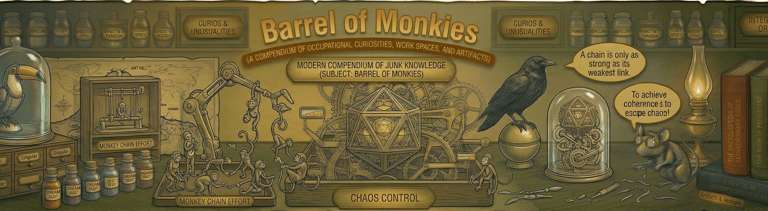
The Definition
A source of immense fun, laughter, or chaotic entertainment. To be "more fun than a barrel of monkeys" implies a level of amusement that is rowdy, unpredictable, and impossible to ignore.
The Deep Dive
This is a "high-energy" piece of junk knowledge that evolved from a literal (and likely very smelly) 19th-century reality into a plastic 20th-century icon.
The Traveling Menagerie: In the mid-1800's, before zoos were common, "showmen" traveled the countryside with exotic animals. Monkeys were the star attraction because of their "human-like" antics. To save space during transport, smaller primates were often kept in large wooden barrels.
The "Chaos" Factor: When a barrel was opened for a performance, the monkeys wouldn't just step out; they would explode out in a tangled, shrieking, somersaulting mass of limbs and tails. To a Victorian audience, this sudden burst of "animal spirits" was the peak of hilarious, unscripted entertainment.
The Linguistic Turn: By the 1890's, "barrel of monkeys" had become a common Americanism for any situation that was lively and slightly out of control. It was famously used in early Vaudeville scripts to describe a particularly fast-paced comedy routine.
The phrase was immortalized for the modern era in 1965 by the Lakeside Toys company. They took the chaotic "tangle" of the idiom and turned it into a game of skill. The goal was to hook the S-shaped arms of small plastic monkeys together to form a chain without dropping any. The game was so successful that for many Baby Boomers and Gen X-ers, the "barrel" is no longer a wooden shipping container, but a bright red plastic tub.
Fast Facts
The "Cage" Rival: Before the barrel became the standard, people often said "more fun than a cage of monkeys." The barrel won out in the American lexicon, likely because of the "surprise" element of opening it.
The "Monkey Business" Link: This is a linguistic cousin. While a "barrel" is fun, "monkey business" (coined around the same time) refers to the more mischievous, deceitful side of primate behavior.
The First Print: The specific comparison "more fun than a barrel of monkeys" began appearing in regional US newspapers like the Galveston Daily News in 1895.
References
Lakeside Toys. (1965). Game of Barrel of Monkeys: Instructions and Lore.
Ammer, C. (2013). The Dictionary of Clichés. Skyhorse Publishing.
Flexner, S. B. (1982). Listening to America. Simon & Schuster.
The Oxford English Dictionary. (2026). Monkey (n.1). Oxford University Press.