The Definition
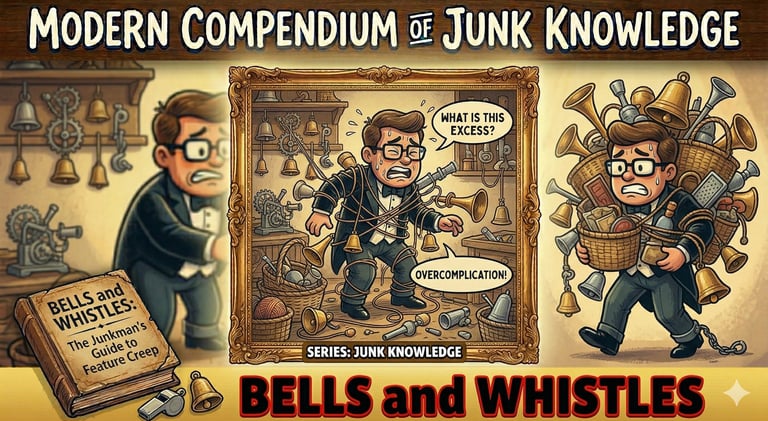
Extra features or trimmings added to a product or system to make it more attractive or impressive, though they are often not essential to its core function. It implies a degree of "flash" over "substance."
The Deep Dive
The "junk knowledge" surrounding this phrase often points to 1950's cars or early computers. However, the origin is much louder and older, rooted in the golden age of the steam locomotive and the Fairground Organ.
In the mid-19th century, a basic train engine needed only two things to communicate: a whistle (to warn those far away) and a bell (to warn those nearby at crossings). These were the "standard equipment."
The Deluxe Engine: As competition between railroad companies grew, they began to commission "prestige" locomotives. These engines were outfitted with multiple tuned whistles (chime whistles) and ornate, silver-plated bells. These extra "bells and whistles" didn't make the train faster or stronger, but they made the engine—and the company—look and sound more expensive.
The Fairground Organ: Simultaneously, massive mechanical organs (like the Wurlitzer) used in carousels and circuses were being built with literal bells, whistles, drums, and castanets attached to the sides. These "trappings" were purely for show, designed to create a "spectacle" of sound that drew in the crowds.
The phrase moved into the general lexicon in the early 20th century to describe any machine that had more "gadgets" than it strictly needed. By the 1960's, it became the go-to term for software developers and car salesmen to describe optional (and often pricey) add-ons.
Fast Facts
The "Silent" Shift: In modern tech, "bells and whistles" are often digital features (like animations or sound effects) that can actually slow down a program—the digital equivalent of a train carrying too much brass.
The Chime Whistle: Unlike a standard "shriek" whistle, a chime whistle used three to five different notes to create a musical chord, making the locomotive sound more "majestic."
The Wurlitzer: The "Mighty Wurlitzer" theater organs were the kings of bells and whistles, featuring everything from bird whistles to sleigh bells operated by the organist’s feet.
References
White, J. H. (1979). A History of the American Locomotive: Its Development: 1830-1880. Dover Publications.
Ord-Hume, A. W. J. G. (1978). Barrel Organ: The Story of the Mechanical Organ and Its Repair. George Allen & Unwin.
Ammer, C. (2013). The Dictionary of Clichés. Skyhorse Publishing.
The Oxford English Dictionary. (2026). Bell (n.1) and Whistle (n.). Oxford University Press.