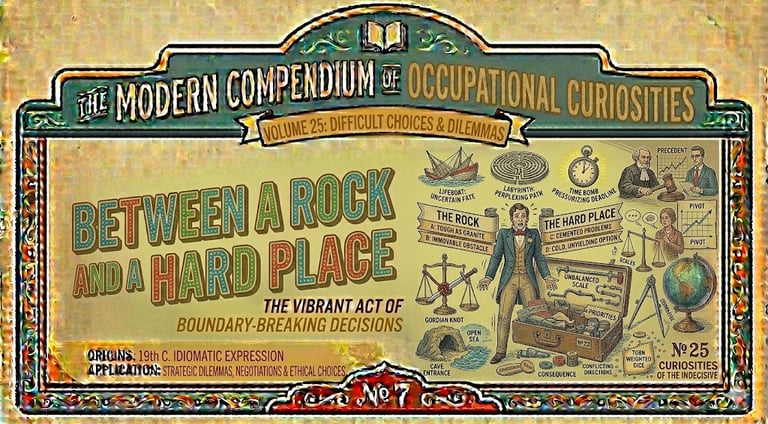
Between a Rock and a Hard Place
The Definition
To be "between a rock and a hard place" means to face a dilemma where you must choose between two equally difficult, unpleasant, or hazardous courses of action. It signifies a state of absolute strategic paralysis, where moving in any direction guarantees an unfavorable outcome.
The Deep Dive
While the sentiment of being trapped between two evils is ancient, the exact phrasing of this idiom is a modern American invention rooted in the harsh realities of late-19th-century labor strikes and frontier mining.
The Classical Ancestor: Long before the American idiom took shape, the ancient Greeks used a parallel myth to describe the exact same psychological trap: Scylla and Charybdis. In Homer’s Odyssey, sailors navigating a narrow strait had to choose between sailing too close to Scylla (a six-headed cliff monster) or Charybdis (a deadly whirlpool). To avoid one was to invite destruction by the other, birthing the classical phrase "between Scylla and Charybdis."
The Banking Panic of 1893: The modern phrasing began taking shape in the western United States during a period of severe economic depression. The earliest recorded uses of the phrase appear in Arizona and Texas newspapers around the turn of the 20th century. Originally, it wasn't a literary device; it was an economic description of bankrupt ranchers and local bankers who found themselves squeezed between a rock (unyielding, frozen real estate assets) and a hard place (the harsh, unforgiving demands of Eastern creditors).
The Rock of the Mines: By the 1910’s, the phrase was heavily adopted by the Western Federation of Miners during a series of brutal, violent labor disputes in Colorado and Montana. For a hard-rock miner, the phrase was brutally literal. To go on strike meant facing the "hard place" of starvation, poverty, and eviction from company-owned housing. To return to work meant going back underground into the crushing, hazardous "rock" of the mine for pennies under hostile management.
The Linguistic Settle: The phrase was officially codified into the broader American lexicon during the 1915 labor union movements. It quickly eclipsed the older British equivalent, "between the devil and the deep blue sea" (a nautical term referring to the hazardous task of caulking a ship's outermost hull seam). The public favored "between a rock and a hard place" because its harsh, percussive phonetics perfectly matched the unyielding, grit-baked reality of modern industrial life.
Fast Facts
The Nautical Alternative: The cousin phrase "between the devil and the deep blue sea" has nothing to do with Satan. The "devil" was the sailor's slang for the longest seam on a wooden ship's hull. Placed right at the waterline, a sailor suspended in a harness to repair it was positioned precariously between the wood of the ship (the devil) and the open ocean.
The Double Bind: In modern psychology and linguistics, this situation is classified as a "double bind" or an "approach-avoidance conflict," where an individual is confronted with choice options that carry exclusively negative reinforcers.
References
Mencken, H. L. (1936). The American Language. Alfred A. Knopf.
Ammer, C. (2013). The Dictionary of Clichés. Skyhorse Publishing.
Oxford English Dictionary. (2026). The Frontier Mining Dialects and Economic Idioms of the American West.