Between the Devil and the Deep Blue Sea
The Definition
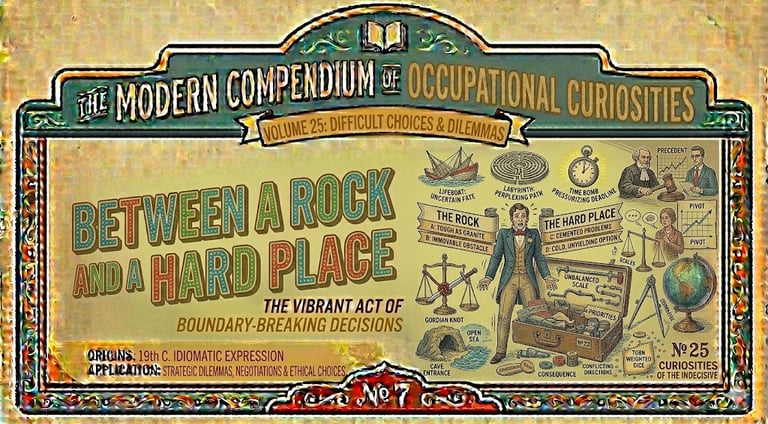
To be "between the devil and the deep blue sea" means to be trapped in a precarious dilemma where you are forced to choose between two equally dangerous, terrifying, or destructive paths. Much like its land-bound cousin, "between a rock and a hard place," it signifies that any choice made will lead to a severe hazard.
The Deep Dive
While modern ears assume the "devil" in this phrase refers to Satan, the idiom's true origin is completely secular, rooted entirely in the grueling, high-stakes world of wooden shipbuilding and maritime maintenance.
The Anatomy of the Ship's Hull: On a classic wooden sailing ship, the seams between the massive oak planks had to be packed with a mixture of unraveled rope fibers (oakum) and sealed with boiling, sticky hot pitch to keep the vessel watertight. The outermost, longest seam on the ship—running along the hull right at or just above the waterline—was notoriously difficult to access. Because of the extreme difficulty of maintaining it, sailors nicknamed this specific seam the devil.
The Perilous Seam Assignment: When a ship was at sea and developed a leak along this critical line, a sailor had to be lowered over the side of the vessel in a primitive rope harness or a wooden staging plank to recaulk the seam. As the ship rolled and pitched in the open ocean, the mariner was suspended in mid-air. They were positioned literally between the "devil" (the stubborn, stubborn seam on the wooden hull) and the deep blue sea (the freezing, churning ocean waiting directly beneath them). One slip of the foot or a sudden wave meant drowning or being crushed against the side of the vessel.
The Religious Cross-Pollination: The phrase first appeared in print in the early 1600’s, heavily popularized during the maritime expansions of the British Empire. However, because the word "devil" carried such a massive, terrifying spiritual weight in society, the public quickly stripped the phrase of its nautical mechanics. The collective imagination transformed the literal wooden plank seam into the Prince of Darkness himself, turning a practical description of a hazardous job into a grand, moral metaphor for being caught between damnation and disaster.
The Nautical Legacy: The maritime "devil" left behind several other common phrases in the English language. For instance, the expression "the devil to pay and no pitch hot" originally meant that a critical leak had been discovered in the hull seam (the devil to pay, where "pay" is the old nautical term for sealing a seam), but the crew was entirely unprepared because the boiling tar (pitch) wasn't ready to use.
Fast Facts
To "Pay" the Devil: In historical maritime journals, the word "pay" did not mean exchanging currency. It was derived from the Old French word peier, meaning to rub or cover a surface with liquid tar. Therefore, "paying the devil" was simply the act of waterproofing a ship's hull.
The Jazz Age Revival: The idiom found a massive second life in American pop culture in 1931, when Cab Calloway and Ted Koehler wrote the hit jazz standard "Between the Devil and the Deep Blue Sea." This track flipped the dark, life-or-death survival metaphor into a lighthearted song about being helplessly trapped by a complicated, volatile romance.
References
Smyth, W. H. (1867). The Sailor's Word-Book: An Alphabetical Digest of Nautical Terms. Blackie and Son.
Ammer, C. (2013). The Dictionary of Clichés. Skyhorse Publishing.
Oxford English Dictionary. (2026). The Material Culture of Wooden Shipbuilding and the Evolution of Maritime Metonyms.