The Definition
An important, powerful, or influential person. It describes someone who holds a high rank in a hierarchy, often used with a touch of irony to suggest that their self-importance is as large as their title.
The Deep Dive
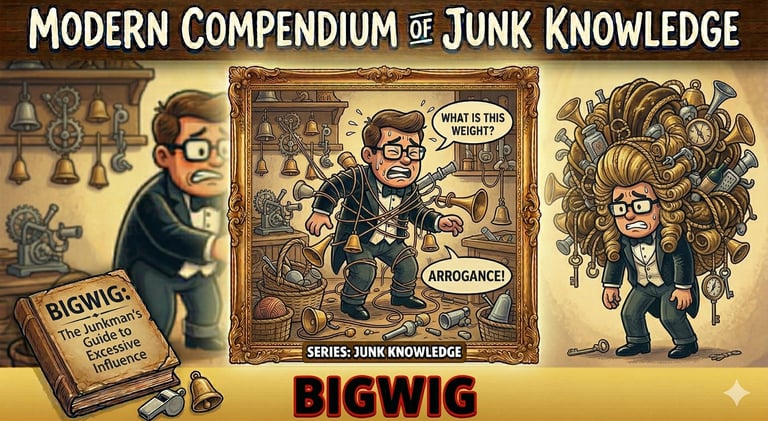
This is a literal piece of "junk knowledge" from the high-society salons of 18th-century Europe. Before the French Revolution made "natural" hair fashionable again, your social status was measured by the literal height and weight of the wig you wore.
In the Georgian era (c. 1714–1837), wigs were not just for covering baldness; they were mandatory formal wear for the upper classes, the judiciary, and the clergy.
The Hierarchy of Hair: The more expensive and elaborate the wig, the higher the wearer's status. While a clerk or a merchant might wear a modest "bob-wig," a high-ranking aristocrat or a Lord Chancellor would wear a full-bottomed wig. These massive constructions of powdered horsehair or human hair draped over the shoulders and down the chest.
The "Big" Expense: These wigs were incredibly heavy, hot, and expensive to maintain. A "big wig" could cost the equivalent of several thousand dollars today. Consequently, if you saw a man in a massive, floor-dusting wig, you knew immediately that he was a person of immense wealth and political "weight."
The term moved from a literal description to a metaphorical one in the early 1800's. As the fashion for wigs died out (thanks in part to a 1795 tax on hair powder), the memory of the "big-wigged" elite remained. By the mid-19th century, any powerful boss or official was called a "bigwig," regardless of whether they were wearing a wig or their own receding hairline.
Fast Facts
The Legal Exception: The "bigwig" tradition survives today in the British legal system, where judges and senior barristers still wear traditional wigs in court, though they are much smaller than the 18th-century originals.
Wig Thieves: Because big wigs were so valuable, "wig-snatching" became a common crime in London. Thieves would reach out of windows or use trained monkeys to snatch the expensive hair off the heads of passing "bigwigs."
The "Powder Monkey": The servants who had to maintain these wigs used blow-pipes to spray scented flour or starch (hair powder) onto the hair—a messy job that eventually led to the phrase "powder room."
References
Cox, N. (1989). The History of the Wig. B.T. Batsford Ltd.
Grose, F. (1785). A Classical Dictionary of the Vulgar Tongue. S. Hooper.
Ammer, C. (2013). The Dictionary of Clichés. Skyhorse Publishing.
Pointon, M. (1993). Hanging the Head: Portraiture and Social Formation in Eighteenth-Century England. Yale University Press.