Bird in the Hand
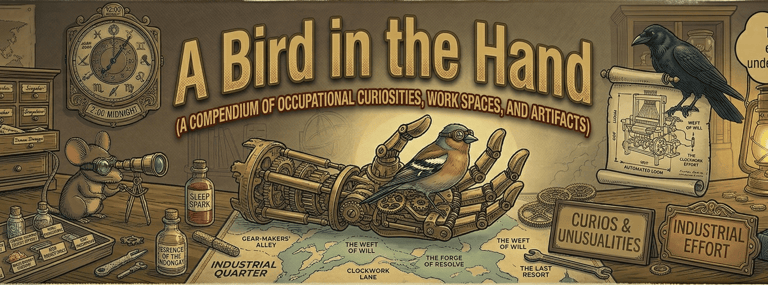
The Definition
A proverb meaning it is better to hold onto something you already have than to risk losing it by trying to get something better that is not guaranteed. It is the ultimate warning against greed and the "gambler’s fallacy," prioritizing certainty over potential.
The Deep Dive
The "junk knowledge" behind "A bird in the hand" is its likely origin in the elite sport of medieval falconry. While the sentiment of "don't trade a sure thing for a maybe" is ancient, the specific imagery of the bird and the bush reflects a very practical reality for the 13th-century nobility.
The Falcon as the Asset: In falconry, the "bird in the hand" wasn't prey; it was the trained falcon itself—an incredibly valuable, expensive, and time-consuming asset to maintain. The "two in the bush" were the wild birds the falcon was supposed to hunt.
The High-Stakes Choice: If a falconer let their bird fly after prey that retreated into thick "bush" or heavy cover, there was a significant risk the falcon would be injured or simply fly away and never return. A wise hunter knew that having the falcon safely on their glove (in the hand) was worth more than risking that asset for the mere possibility of catching two wild birds.
The Linguistic Evolution: The phrase has existed in various forms for over 2,500 years. An Aramaic version from 700 BCE mentioned "a sparrow in thy hand is better than a thousand sparrows flying." However, the "two in the bush" version we use today was cemented in English literature around the 15th and 16th centuries, notably appearing in the 1670 Hand-book of Proverbs by John Ray.
The phrase reached peak "junk" status as a foundational pillar of Modern Economics. It is the folk-wisdom version of "Risk Aversion." It represents the "junk" of human survival: the hard-wired instinct that suggests the pain of losing what we already possess is far greater than the joy of gaining something new.
Fast Facts
The "Two" Variation: Earlier English versions weren't so specific about the number "two." In 1530, it was "A bird in hand is worth ten fly at large," and in 1546, it was "Better one bird in hand than ten in the wood."
The Global Flavor: Other cultures have their own versions: the Czechs say, "A sparrow in the fist is better than a pigeon on the roof," and in the 2nd-century Kama Sutra, it is noted that "a pigeon to eat is better than a peacock in the sky."
Bird in Hand, PA: There is a village in Pennsylvania named "Bird-in-Hand." Legend says that in 1734, two surveyors stayed at a local inn and discussed whether they should move on to find a better location or stay put; they decided "a bird in the hand" was better, and the name stuck to the town.
References
Ray, J. (1670). A Hand-book of Proverbs.
Capgrave, J. (1450). The Life of St. Katherine. (Earliest English recording of the "bird in the fist" sentiment).
Ammer, C. (2013). The Dictionary of Clichés. Skyhorse Publishing.
The Oxford English Dictionary. (2026). Bird (n.). Oxford University Press.