Birds of a Feather
The Definition
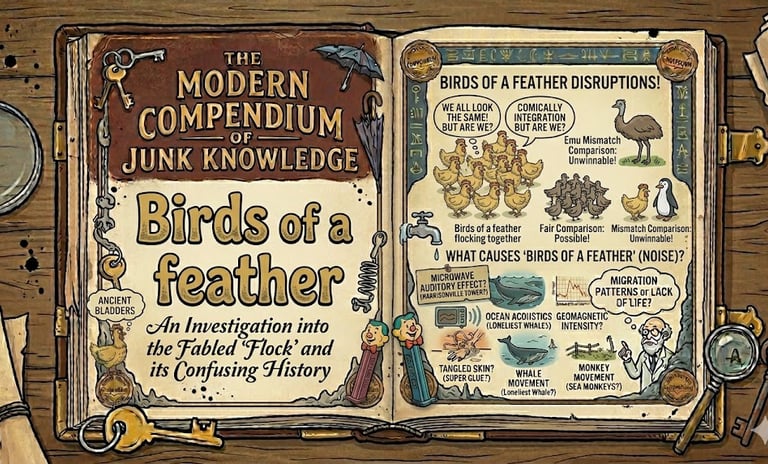
A shortened version of the proverb "Birds of a feather flock together." It describes the tendency for people with similar characters, interests, or backgrounds to associate with one another. In modern social science, this is known as homophily—the "love of the same."
The Deep Dive
The "junk knowledge" behind "birds of a feather" is that it isn't just a casual observation; it was originally a warning about the fragility of reputation. In the 16th century, the phrase was less about finding your "tribe" and more about the company you kept being used as evidence of your own moral failings.
The Minsheu Connection: While the concept is ancient (appearing in the works of Aristotle and the Bible), the specific English phrasing is credited to William Minsheu in his 1599 dictionary, The Guide into the Tongues. He noted that "Birdes of a feather, will flye together," implying that a person’s character could be accurately judged by simply looking at their social circle.
Literal Biology: In nature, "flocking together" is a survival mechanism. Different species have different wing shapes, flight speeds, and foraging habits. A sparrow cannot keep pace with a hawk, and a duck has no business in a forest canopy. Birds of the same "feather" (plumage and wing structure) flock together because their physical capabilities are synchronized.
The Darker Social Layer: For much of history, the idiom was used to justify social segregation. If "birds of a feather" should stay together, then any bird attempting to join a different flock was seen as an interloper or a "social climber."
The phrase reached peak "junk" status in the 20th century as the favorite cliché of high school guidance counselors and sociologists. It represents the "junk" of human intuition: the comfort we find in mirrors and our evolutionary suspicion of the "different."
Fast Facts
The Mathematical Validation: Sociologists have found that "Birds of a Feather" is one of the most consistent rules in human networking. We are statistically more likely to marry, work with, and live near people who share our ethnicity, education level, and even our name initials (a phenomenon called "Implicit Egotism").
The "Opposites" Conflict: The idiom is frequently paired with its rival: "Opposites attract." While opposites might attract in the short term (romance), "birds of a feather" almost always win in the long term (stability).
The Plumage Factor: In the original meaning, "feather" referred specifically to the uniform or livery worn by servants of a particular noble house. To be of the same "feather" meant you served the same master.
References
Minsheu, W. (1599). Dictionarie in Spanish and English.
McPherson, M., et al. (2001). Birds of a Feather: Homophily in Social Networks. Annual Review of Sociology.
Ammer, C. (2013). The Dictionary of Clichés. Skyhorse Publishing.