Bite Off More Than
You Can Chew
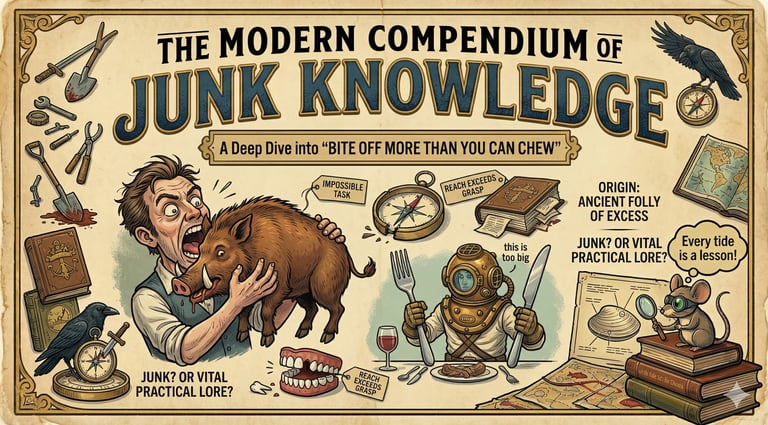
The Definition
To take on a task that is way too big; to over-commit or underestimate the difficulty of a responsibility. It describes the moment realization hits that you are physically or mentally unable to handle what you’ve started.
The Deep Dive
While it sounds like a simple warning about table manners, this phrase didn't originate at the dinner table. It comes from the gritty, communal world of plug tobacco in 19th-century America.
Before cigarettes became the dominant form of nicotine, many people—miners, sailors, and farmers—carried "plugs" of pressed, sweetened tobacco. When someone wanted a "chew," they would either cut a piece off with a pocketknife or, if they were in a hurry or didn't have a tool, they would simply sink their teeth into the solid block and pull.
The Social Etiquette: Tobacco was often shared. If a friend offered you their plug, the unwritten rule was to take a modest amount.
The Greedy Gulp: To "bite off more than you can chew" was to take such a massive hunk of the dense tobacco that your jaws couldn't actually move to process it. You were left with a bulging cheek, unable to spit, swallow, or speak, looking both greedy and ridiculous.
The phrase moved from the tobacco-spattered floors of general stores into the American lexicon in the mid-1800's. It became a favorite metaphor for the "Manifest Destiny" era, describing speculators and pioneers who took on more land or more debt than they could possibly manage.
Fast Facts
The "Plug" Construction: Tobacco plugs were made by pressing leaves under heavy weights and binding them with molasses or licorice, making them incredibly tough and difficult to "bite" through.
The First Print: While it was common frontier slang for decades, the phrase began appearing in Western newspapers and humor magazines like Puck and Judge in the 1870's.
The Clinical Twist: In modern psychology, this is often linked to "The Planning Fallacy"—the human tendency to underestimate how much time and effort a task will take, regardless of past experience.
References
Ammer, C. (2013). The Dictionary of Clichés. Skyhorse Publishing.
Robert, J. C. (1949). The Story of Tobacco in America. Alfred A. Knopf.
Taggart, C. (2010). Her Who Must Be Obeyed: The Phrases and Sayings That Make Us Who We Are. Michael O'Mara Books.
The Oxford English Dictionary. (2026). Bite (v.). Oxford University Press.