Bite the Bullet
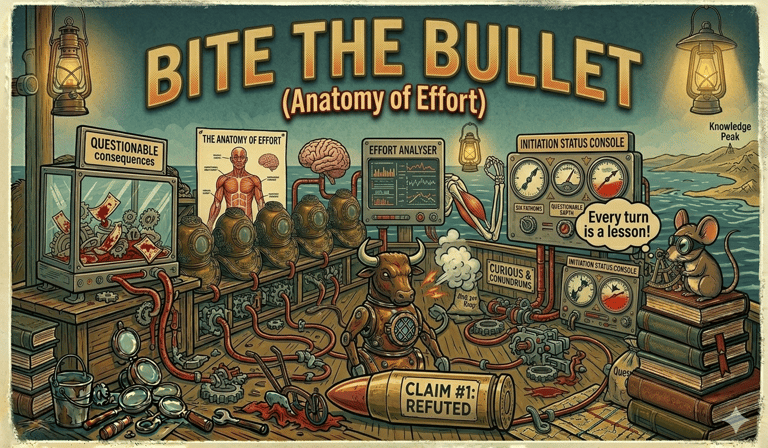
The Definition
To accept something difficult or unpleasant that is otherwise unavoidable. It conveys a sense of stoicism and "getting it over with" despite the anticipated pain.
The Deep Dive
The most common "junk knowledge" explanation for this phrase is that it originated on 19th-century battlefields. The story goes that before the advent of reliable anesthesia (like ether or chloroform), a wounded soldier would be given a lead bullet to clench between his teeth to keep from screaming—and to keep from biting off his tongue—while a surgeon performed a frantic amputation or extracted a shard of shrapnel.
While this makes for a gritty cinematic image, the linguistic reality is a bit more nuanced:
The "Paper Cartridge" Theory: Before the mid-1800's, soldiers used "paper cartridges" which held a pre-measured amount of gunpowder and a lead ball. To load their muskets, soldiers had to "bite the bullet" out of the paper to pour the powder down the barrel. Doing this under heavy fire required immense focus and nerves of steel, which likely contributed to the "bravery" connotation of the phrase.
The "Bite the Ball" Precursor: A similar expression, "to bite the ball," appeared as early as 1785 in Francis Grose’s A Classical Dictionary of the Vulgar Tongue. It referred to a practice where a soldier being flogged would bite a lead ball to endure the pain without crying out, which would be considered unmanly.
The phrase was officially "modernized" by Rudyard Kipling in his 1891 novel The Light That Failed, where he wrote: "Steady, Dickie, steady! Biting the bullet helps."
Fast Facts
The Material: Lead was chosen for these (alleged) medical bites because it is a relatively soft metal that wouldn't shatter the patient's teeth.
The Culinary Link: Some linguists suggest a link to the phrase "chew the bullet," which means to ponder something deeply or "chew" on a difficult problem.
Medical Reality: In actual 19th-century naval or army journals, leather straps or wood were more commonly used than bullets, as they were easier to grip and less of a choking hazard.
References
Grose, F. (1785). A Classical Dictionary of the Vulgar Tongue. S. Hooper.
Kipling, R. (1891). The Light That Failed. United States Book Company.
Martin, G. (2005). The Phrase Finder. (Online Database).
Wilkes, G.A. (1978). A Dictionary of Australian Colloquialisms. Sydney University Press.