Black Sheep
The Definition
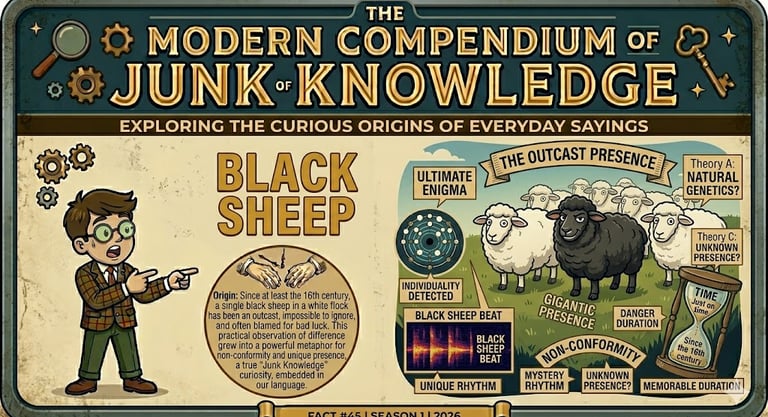
A "black sheep" is a member of a family or group who is considered different, eccentric, or disreputable by the other members. It describes an individual whose behavior, beliefs, or lifestyle fall outside the expectations of the collective, often resulting in them being marginalized or viewed with disapproval.
The Deep Dive
This idiom is a literal observation from the world of 18th-century sheep farming that carried heavy economic and symbolic weight.
The Genetic "Junk" Trait: In a flock of white sheep, a black lamb is born due to a recessive gene. Unlike white wool, which can be dyed any color to meet market demands, black wool was historically considered "junk" because it was difficult to dye and of lower commercial value. To a shepherd, a black sheep represented a loss of profit.
The "Bad Omen" Superstition: Beyond the financial loss, black sheep were often burdened with religious and superstitious baggage. In many European cultures, a black sheep was seen as a sign of the devil or a curse upon the flock. This turned a simple biological variation into a moral judgment.
Social Migration: By the late 1700’s, the term moved from the pasture to the parlor. It became a convenient way to describe a family member whose "wool" didn't match the rest of the flock—someone who didn't follow the family trade, held radical politics, or simply possessed a personality that the rest of the group found "un-dyeable."
The Modern Reclaim: Interestingly, the 21st century has seen a shift in how the term is used. Many people now wear the "black sheep" label as a badge of pride, representing independence, authenticity, and the courage to break away from a stifling family dynamic.
Fast Facts
The "Black Goat" Equivalent: In some Mediterranean cultures, the "black goat" serves the same idiomatic purpose, though "black sheep" remains the dominant English expression.
The 18th Century Peak: The phrase's first recorded use in a non-literal sense appears in the mid-1700's, coinciding with the rise of the industrial wool trade in Britain.
References
Ammer, C. (2013). The Dictionary of Clichés. Skyhorse Publishing.
Ayto, J. (1990). Dictionary of Word Origins. Arcade Publishing.
Oxford English Dictionary. (2026). Agricultural Economics and the Language of Social Ostracization.ena.