Blockhead
The Definition
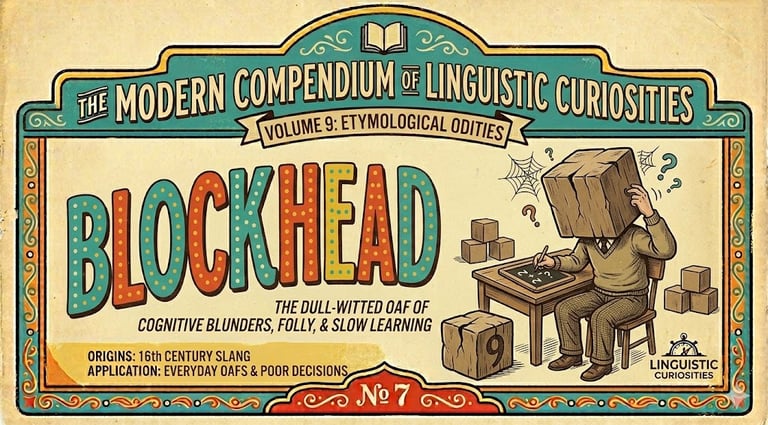
A derogatory idiom used to describe a person who is perceived as exceptionally dull, stupid, or "thick-skulled." It suggests that the person’s head is not filled with a functioning brain, but is instead a solid, unyielding "block" of wood or stone—making it a "tall order" for any new information to penetrate.
The Deep Dive
The "junk knowledge" behind "blockhead" is that it is a craftsmanship metaphor dating back to the 16th century. It originated from the literal "blocks" used by tradespeople to shape or display items meant for the human head.
The Milliner’s Form: In the 1500's, hat-makers (milliners) and wig-makers used a wooden carving of a human head—known as a head-block—to mold their wares. These blocks were, by definition, silent, unthinking, and incapable of learning. To call someone a "blockhead" was to suggest they were as intellectually useful as the wooden mold sitting on a tailor's workbench.
The "Wooden" Stupidity: In English "junk" history, wood has long been the go-to material for insults regarding intelligence (see also: "thick as a plank"). The "brass tacks" of the insult is the lack of "grain" or movement; a blockhead is someone whose opinions are "carved in wood" and cannot be changed by logic or evidence.
The Peanuts Connection: While the term is ancient, it reached a peak in modern "junk" culture through Charles Schulz’s Peanuts comic strip. Lucy van Pelt’s frequent use of the term toward Charlie Brown transformed it from a harsh 16th-century insult into a piece of classic Americana shorthand for someone who just can't seem to get the "hang" of things—like kicking a football.
The phrase reached peak "junk" status in the mid-20th century. It represents the "junk" of frustration: the moment when you realize you are "at odds" with someone whose mind is simply "closed for business."
Fast Facts
The "Chip Off the Old Block" Irony: While being a "blockhead" is an insult, being a "chip off the old block" is often a compliment. The "block" in the latter refers to the sturdy, high-quality substance of the parent, rather than the density of the child’s skull.
The Shakespearean "Block": Shakespeare used "block" to describe stupidity in Much Ado About Nothing, proving that calling people "wooden" has been a "license to print money" for writers for over 400 years.
The "Bonehead" Variant: In the early 20th century, "blockhead" spawned "bonehead," shifting the material from wood to skeleton, but keeping the "brass tacks" meaning of being "solid all the way through."
References
Schulz, C. M. (1950–2000). Peanuts. (Comic Strip).
Ammer, C. (2013). The Dictionary of Clichés. Skyhorse Publishing.
Oxford English Dictionary. (2026). The Etymology of Wood-Based Pejoratives.