Blood is Thicker than Water
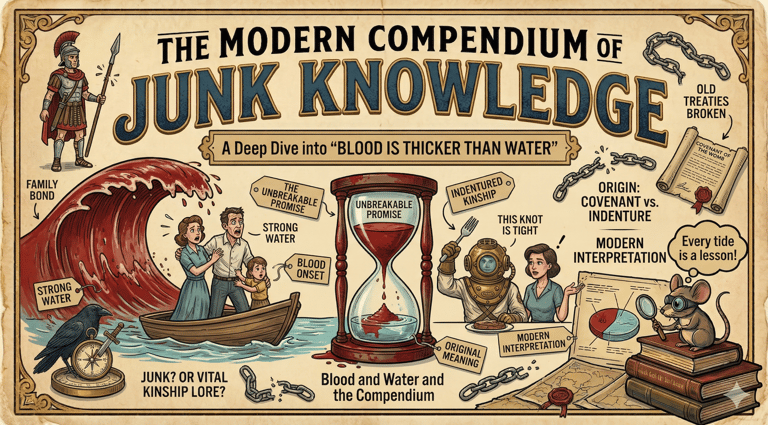
The Definition
The belief that family ties are stronger and more important than any other relationship, including friendships or professional alliances. It implies that when a crisis hits, you can only truly rely on those who share your DNA.
The Deep Dive
This is perhaps the most "reversed" piece of junk knowledge in the English language. In modern usage, we use it to elevate the importance of the nuclear family. However, a popular (though hotly debated) theory suggests that the original meaning was exactly the opposite.
The "full" version often cited by linguists and historians is: "The blood of the covenant is thicker than the water of the womb."
The Blood of the Covenant: This refers to the bonds formed between comrades in battle (who shed blood together) or through ancient "blood oaths" of loyalty. It suggests that a chosen bond—one forged in shared hardship or sacrifice—is more binding than a mere biological accident.
The Water of the Womb: This refers to the amniotic fluid of birth. In this "original" context, "water" is the weaker substance. The message was that the brothers you choose to bleed with are more important than the brothers you happen to be born with.
The phrase moved from these ancient, gritty origins into the German and English languages in the Middle Ages. It appeared in the 12th-century German epic Reynard the Fox as "Blood is not water," implying that family members shouldn't treat each other like strangers. By the time it reached the 19th century, the "Covenant" part had been largely stripped away, and the Victorian obsession with family values cemented the "Blood = Family" interpretation we use today.
Fast Facts
The Naval Twist: In 1859, U.S. Navy Commodore Josiah Tattnall used the phrase to justify helping the British during a battle against China, despite American neutrality. He argued that his "blood" (shared Western heritage) outweighed the "water" of international law.
The First English Print: The proverb appeared in John Ray’s Collection of English Proverbs in 1670 in its shortened, modern form.
The Biological Reality: Physically, blood is roughly three to four times thicker (more viscous) than water, primarily due to the presence of red blood cells and plasma proteins.
References
Ray, J. (1670). A Collection of English Proverbs. Cambridge University.
Pithan, E. (1994). The Blood of the Covenant. (Exploration of the "reversed" meaning).
Rogers, J. (1985). The Dictionary of Clichés. Facts on File Publications.
The Oxford Dictionary of Proverbs. (2026). Blood. Oxford University Press.