Blue Blood
The Definition
A person of noble, aristocratic, or wealthy ancestry. It describes someone born into a "high" social class, implying that their lineage is pure and untainted by the toil of the common masses.
The Deep Dive
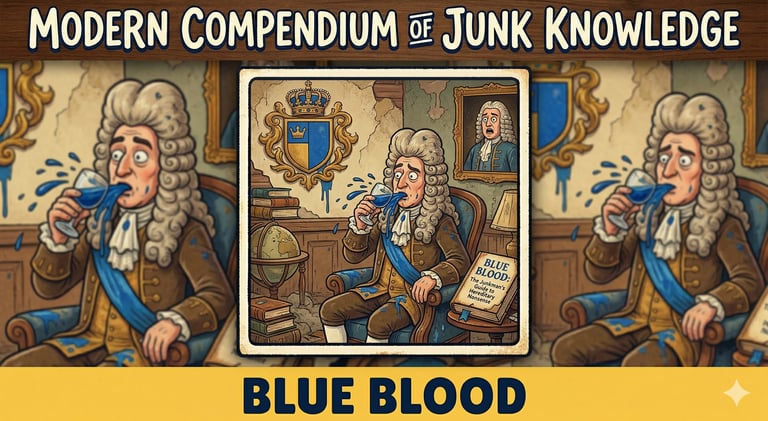
While modern science tells us that all human blood is various shades of red (depending on oxygenation), the "junk knowledge" behind this phrase is a literal observation of 9th-century skin. The term is a direct translation of the Spanish "sangre azul."
The phrase originated in medieval Castile, Spain, during the Reconquista—the long period when Christian kingdoms fought to retake the peninsula from the Moorish (North African) caliphates.
The Pale Privilege: The Spanish aristocracy took immense pride in their "Gothic" ancestry, claiming they were descendants of the fair-skinned Visigoths. Unlike the peasant class, who spent their days laboring in the scorching Spanish sun, the nobility lived indoors or under shade.
The Visual Proof: Because the aristocrats were so pale, their veins were highly visible through their translucent skin. To the medieval eye, these veins appeared to carry blue liquid.
The "Untainted" Line: Having "blue blood" was a physical badge of honor. It proved that the person had not "tarnished" their lineage by intermarrying with the darker-skinned Moors or by performing manual labor that would result in a common, sun-darkened tan.
The phrase moved into English in the early 1800's, just as the Industrial Revolution was creating a new class of wealthy factory owners. The old "blue-blooded" landed gentry used the term to distinguish themselves from the "new money" families whose skin might be pale, but whose ancestry lacked the ancient, "blue" pedigree of the medieval knights.
Fast Facts
The Science of Blue: Veins appear blue because of how light interacts with skin and blood. Red light (longer wavelength) penetrates deeper into the tissue, while blue light (shorter wavelength) is reflected back to our eyes.
The Horseshoe Crab: In a twist of biological irony, horseshoe crabs actually do have blue blood. Their blood uses copper-based hemocyanin to carry oxygen, which turns bright blue when exposed to air.
The "Royal Blue" Link: While "Royal Blue" is a color often associated with this idiom, the name of the color actually originated from a dress made for Queen Charlotte in the late 1700's, reinforcing the link between the hue and the throne.
References
Bernstein, L. (1986). The Castilian Aristocracy and the Concept of Sangre Azul. University of Pennsylvania Press.
Ammer, C. (2013). The Dictionary of Clichés. Skyhorse Publishing.
Grose, F. (1811 edition). Dictionary of the Vulgar Tongue.
The Oxford English Dictionary. (2026). Blue (adj. and n.). Oxford University Press.