Blue Devils
The Definition
As an institutional or athletic moniker, the "Blue Devils" is famously recognized as the sports identity of Duke University. Historically, however, the term has a dual lineage: it began as a 16th-century English idiom for clinical depression and the hallucinatory terrors of alcohol withdrawal, before being completely inverted into a global symbol of elite, unyielding military courage during World War I.
The Deep Dive
The phrase traces a fascinating trajectory through human history, evolving from an invisible mental illness into an elite physical force.
1. The Somber Origin: The "Blue Devils" of the Mind
Long before the phrase was chanted in packed basketball arenas, "the blue devils" was a chilling piece of early modern English slang used to describe a suffocating frame of mind.
The Melancholy Spells: Dating back to 1599, British writers used the term to describe profound, paralyzing depressive episodes, believing that low spirits allowed blue, melancholy demons to temporarily possess a person's thoughts.
The Birth of "The Blues": By the mid-18th century, the public shortened the phrase into "the blues." When African American musicians in the Deep South birthed a raw, soulful genre of music in the late 19th century, they drew directly from this centuries-old linguistic root to sing away their grief.
The Hallucinatory Tremors: In 19th-century America, the idiom took a stark medical turn, becoming closely associated with the terrifying hallucinations and severe withdrawal symptoms of advanced alcoholism—a condition known clinically as delirium tremens (the DTs). Sufferers frequently reported seeing imaginary blue apparitions, cementing the term as a raw shorthand for physical and mental agony.
2. The Heroic Inversion: Les Diables Bleus
The phrase was completely rescued from its dark, melancholic connotations on the battlefields of Europe during World War I.
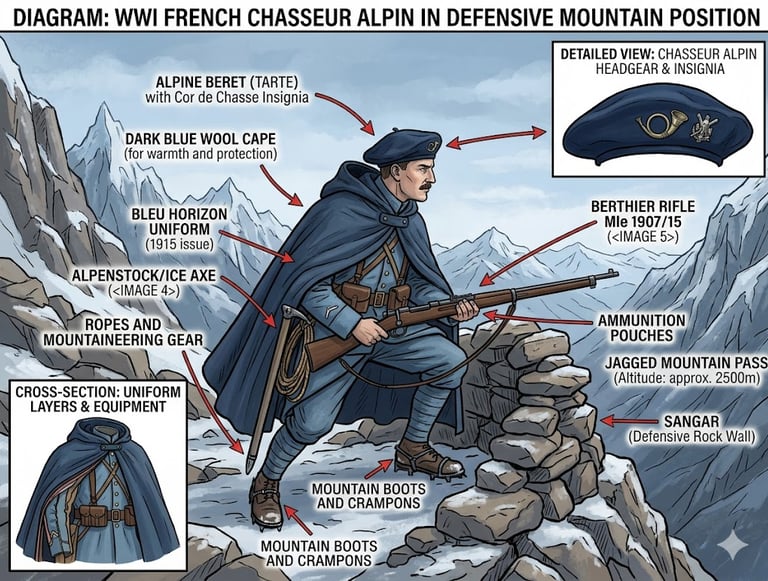
The Alpine Elites: In the late 19th century, the French Army formed an elite mountain infantry unit known as the Chasseurs Alpins (Alpine Chasers). Trained to climb and operate in sub-zero, high-altitude environments, these soldiers wore a striking uniform featuring a flowing dark-blue cape and an oversized alpine beret.
The Vosges Stalwart: When World War I erupted, these French mountain units displayed such ferocious tactical skill, rapid mobility, and stubborn defiance that their German opponents began calling them Die Blauen Teufel—"The Blue Devils." They held the treacherous, snow-choked ridge lines of the Vosges Mountains against overwhelming odds, transforming their blue uniforms into a global symbol of grit.
The Collegiate Metamorphosis
The transition of the Blue Devils from French military heroes into an American sports icon occurred in 1922 at a small Methodist school in Durham, North Carolina, then known as Trinity College (renamed Duke University in 1924 following a massive industrial tobacco endowment).
Following the end of World War I, the school's trustees finally lifted a restrictive, 25-year ban on intercollegiate football. The student newspaper, The Trinity Chronicle, launched a campus-wide contest to establish a permanent mascot.
Nominations flooded in, including the Blue Titans, Polar Bears, and Blue Warriors.
Given the deeply religious Methodist roots of the college, the student nomination of the "Blue Devils" initially triggered intense backlash from local church leaders who feared the name was inherently anti-religious.
However, the student body fiercely defended the choice, citing the heroic, unvarnished patriotism of the French Chasseurs Alpins. The students argued that the mascot represented military honor, grit, and peak physical conditioning rather than spiritual evil. The name won out by a landslide, cementing a permanent baseline for athletic excellence.
Fast Facts
The Blue Devils Drum Corps: Beyond the halls of Duke, the name is world-famous in the performing arts. Founded in Concord, California, in 1957, The Blue Devils Drum and Bugle Corps holds the record for the most Drum Corps International World Championship titles in history.
The Pharmacological Slang: In a strange twist that mirrors the phrase's early medical roots, 1960’s counter-culture street slang used "blue devils" as a common code name for amobarbital sodium (Amytal), a powerful prescription barbiturate depressant manufactured inside a distinct, bright blue capsule.
References
Gay, P. (1968). Weimar Culture and the Fractures of Interwar Europe. Harper & Row.
Ammer, C. (2013). The Dictionary of Clichés. Skyhorse Publishing.
Oxford English Dictionary. (2026). The Lexical Evolution of Early Modern Melancholy Idioms and the Transmutation of Interwar European Military Designations.