Boarding House
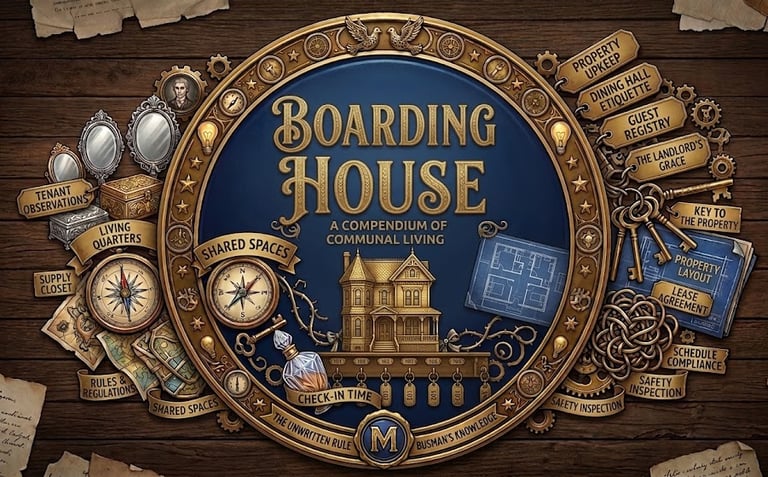
The Definition
A boarding house is a private house that provides lodging and regular meals (referred to as "board") to residents for an extended period. Unlike a modern hotel or motel, which caters to short-term travelers, a boarding house functions as a semi-permanent communal residence, operating under a specific set of domestic rules overseen by a live-in proprietor.
The Deep Dive
The term bridges the gap between medieval culinary logistics and the rapid urbanization of the 19th and 20th centuries.
The Meaning of "Board": The word "board" in this context is a direct linguistic fossil from the Middle Ages. In medieval homes, meals were served on a literal wooden board or plank resting on trestles. Over time, the word for the physical piece of furniture became a metonym for the food served upon it. Therefore, "room and board" literally translates to a space to sleep and a table at which to eat.
The Urban Migration Solution: During the Industrial Revolution, cities swelled with young, unmarried workers who moved away from family farms to work in factories, offices, and docks. These individuals could not afford to buy a home or rent a full apartment, nor did they know how to cook or manage a household. The boarding house emerged as the primary social and economic solution, providing an affordable, pre-managed lifestyle.
The "Landlady" Subculture: Boarding houses were typically managed by widowed or single women, for whom running such an establishment was one of the few socially acceptable ways to earn an independent income. The "boarding house landlady" became a fixed archetype in literature and theater—often portrayed as a strict, eagle-eyed disciplinarian who enforced strict curfews, rationed the butter, and policed the morality of her tenants.
The Communal Dining Catalyst: The defining feature of the boarding house was the shared evening meal. At a designated hour, all residents—ranging from low-wage clerks to aspiring artists—gathered around a single large table. This forced proximity turned boarding houses into vibrant centers of local gossip, political debate, and social networking, serving as the literal melting pots of growing cities.
The Modern Decline: In the mid-20th century, the traditional boarding house largely vanished due to the rise of cheap suburban housing, studio apartments, and stricter municipal zoning laws. However, the core concept has seen a modern resurgence in urban areas under the branding of "co-living spaces"—proving that the economic need for shared housing and communal connection remains unchanged.
Fast Facts
The "Starving Artist" Haven: Many famous historical figures spent their formative years in boarding houses. Edgar Allan Poe, Nikola Tesla, and Walt Whitman all relied on the low cost of room and board to survive while pursuing their early work.
The Nautical Equivalent: On ships, the term "boarding" took a completely different path, meaning to force one's way onto an enemy vessel. In contrast, a "boarding house" on land was meant to be a place of welcome and refuge.
References
Gamber, W. (1997). The Boardinghouse in Nineteenth-Century America. Johns Hopkins University Press.
Ammer, C. (2013). The Dictionary of Clichés. Skyhorse Publishing.
Oxford English Dictionary. (2026). The Evolution of Domestic Lodging and Culinary Metonyms.