Bought for a Song
The Definition
To buy something "for a song" means to purchase it for an exceptionally low price—practically next to nothing. It implies that the item acquired possesses far greater intrinsic or commercial value than the trivial amount of currency exchanged for it.
The Deep Dive
The phrase is a literal description of the fractional economy of early modern Europe, where intangible street entertainment was traded for the smallest copper coins in circulation.
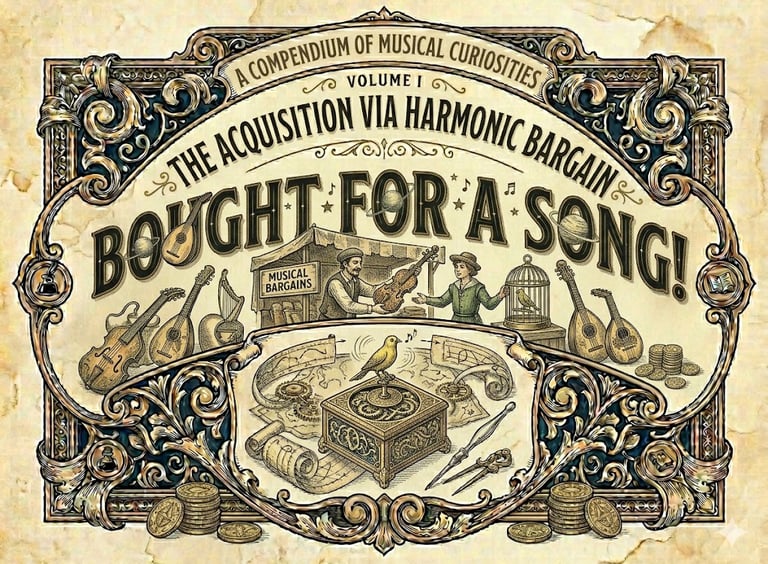
The Traveling Minstrel: In the 15th and 16th centuries, long before recorded music or mass printing, entertainment was purely live and localized. Itinerant musicians, balladeers, and minstrels would travel from town to town, performing on street corners, in taverns, and at rural fairs. Because they had no fixed income, these performers relied entirely on the casual charity of the crowd.
The "Song-Penny": A spectator wishing to show appreciation would toss the singer a single, low-value copper coin—such as a British farthing or a halfpenny. These coins were worth so little that they couldn't purchase a substantial meal or a basic tool. Consequently, the tiniest denomination of money became colloquially known as the price of a song. To say an item was "bought for a song" meant you didn't even have to dip into your silver or gold; you paid with the loose, insignificant copper change you would throw to a street performer.
The Sheet Music Trade: By the late 1500’s, the phrase found a second literal home in the printing press. Printers began churning out broadside ballads—single sheets of cheap paper containing the lyrics and musical notation of popular tunes. These sheets were sold on the street by "peddlers of songs" for a mere penny. If a wealthy merchant purchased a valuable piece of furniture or property from a desperate seller for a ridiculously low sum, onlookers joked that the price paid was no more than the cost of one of those cheap, flimsy sheets of street music.
The Literary Stamp: The idiom was officially cemented into high English literature by William Shakespeare. In All's Well That Ends Well (c. 1603), a character mocks a trivial exchange by remarking that a man "sold a goodly manor for a song." This literary endorsement helped the phrase transition from standard marketplace slang into a permanent, upper-class metaphor for an absolute bargain.
Fast Facts
The "Song and Dance" Contrast: While buying something "for a song" means getting a great deal for very little money, giving someone a "song and dance" means offering a complex, overblown, and fraudulent excuse to distract them from a failure or deception.
The Modern Real Estate Parallel: In contemporary asset management, the phrase is frequently used during economic downturns or liquidations. When a distressed property or a bankrupt company's infrastructure is sold off rapidly to satisfy creditors, it is said to be picked up by savvy investors "for a song."
References
Shakespeare, W. (1603). All's Well That Ends Well. Act III, Scene 2.
Ammer, C. (2013). The Dictionary of Clichés. Skyhorse Publishing.
Oxford English Dictionary. (2026). The Fractional Currency of Early Modern Street Literature and Minstrelsy Slang.