Bought It (Bought the Farm)
The Definition
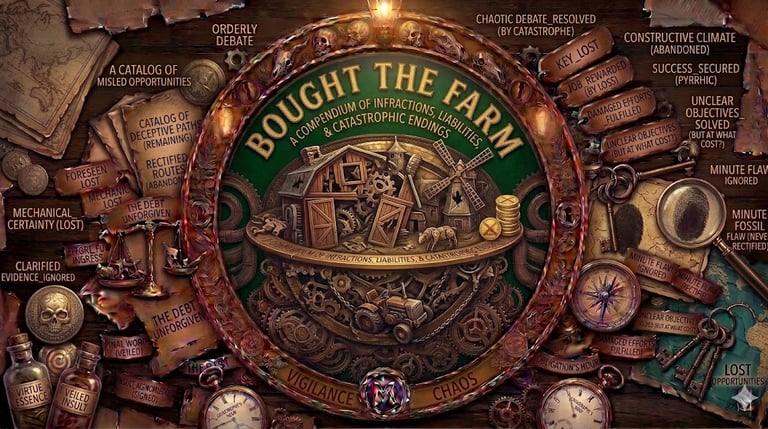
To say someone "bought it" is a somber euphemism meaning they have died, typically in a sudden, violent, or accidental manner. While it can be used colloquially for any death, it has historical roots as military and aviation slang. It is a truncated version of the older, more descriptive phrase, "bought the farm."
The Deep Dive
The phrase is a cynical linguistic inversion, where the ultimate loss of one's life is framed as a standard commercial transaction.
The Early Aviation Crashes: The idiom gained significant traction during the early days of military aviation in the 1910’s and 1920’s, a period when airplanes were notoriously unreliable and training crashes were tragically common. When a student pilot lost control of their aircraft, the plane would frequently plummet into an open field or farm near the airfield, destroying both the machine and the pilot.
The Insurance and Liability Illusion: When a young pilot crashed into a field, the government was held liable for the physical damage caused to the civilian property—ruined crops, destroyed barns, or killed livestock. The joke among surviving airmen was that the crash was so expensive, and the government's payout to the farmer so substantial, that the dead pilot had essentially "bought the farm" with his final act.
The Tragic Dream Settlement: A parallel, more poignant theory involves the universal dream of early 20th-century service members. Many young soldiers and pilots from rural backgrounds dreamed of surviving the war, returning home, and using their combat pay or life insurance to buy a peaceful farm. If a pilot crashed and died, their government-issued life insurance policy ($10,000 during WWII) was paid out directly to their beneficiaries or spouse. This money was often literally used by the grieving family to pay off a mortgage or purchase land—meaning the pilot had paid for the family farm with his life.
The Linguistic Truncation: By the onset of World War II and the Korean War, the phrase was shortened by British and American servicemen to a stark, two-word absolute: "He bought it." It became a cold, defensive linguistic shield used by soldiers to process the abrupt disappearance of a tentmate or wingman without having to say the word "died."
Fast Facts
The British Cousin: In the British Royal Air Force (RAF), a parallel phrase arose during the world wars: "bought a packet." A "packet" referred to a packet of trouble or a bullet, carrying the exact same dark commercial subtext.
Synonymous Inversions: The phrase belongs to a specific family of fatalistic military slang that turns death into a domestic or bureaucratic chore, such as "bit the dust," "croaked," or "cashed in his chips."
References
Green, J. (2010). Green's Dictionary of Slang. Chambers Harrap.
Ammer, C. (2013). The Dictionary of Clichés. Skyhorse Publishing.
Oxford English Dictionary. (2026). The Evolution of Twentieth-Century Military Euphemisms and Aviation Vernacular.