Braille
The Definition
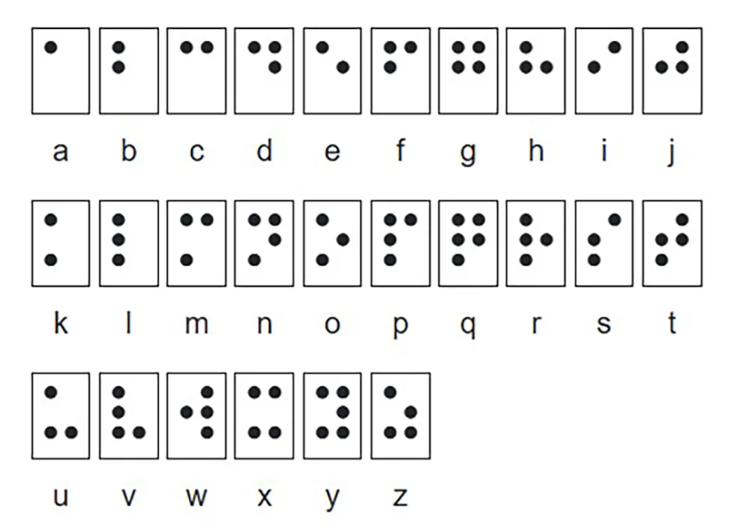
Braille is a tactile writing and reading system utilized worldwide by individuals who are blind or visually impaired. Rather than relying on ink and visual shapes, it uses a highly structured system of raised dots stamped into a surface, allowing the human fingertip to rapidly decode letters, numbers, musical notation, and complex scientific equations through touch alone.
The Deep Dive
The history of Braille is an extraordinary example of unintended consequences—tracking how a clunky, secret tactical military system designed for battlefield survival was re-engineered by a brilliant teenager into a universal instrument of human literacy.
The Napoléon Mandate: The story begins in the early 1800’s with the French army. Napoléon Bonaparte demanded a method of communication that would allow his soldiers to read combat orders, coordinates, and tactical updates in total darkness on the front lines without striking a match or lighting a lantern—an act that would instantly invite enemy sniper fire.
Night Writing: In response, a French artillery captain named Charles Barbier invented a tactical system called Écriture Nocturne ("Night Writing"). Barbier’s system used a two-column grid containing twelve raised dots. By stamping specific combinations of these dots into thick cardboard, a soldier could pass a message along a trench line, feeling the impressions with their thumb to decode the message.
The Critical Flaw: While brilliant in theory, Barbier’s military system was an operational failure. A 12-dot grid was far too physically large. The human fingertip could not cover all twelve dots simultaneously without moving around, meaning it took an immense amount of time to decode a single word. The French army quietly shelved the project.
The Prodigy's Squeeze: In 1821, Barbier visited the Royal Institution for Blind Youth in Paris, where he demonstrated his abandoned military system to the students. Sitting in the audience was a 12-year-old boy named Louis Braille, who had been blinded in a childhood accident in his father's leather harness shop. Louis immediately recognized the immense potential of Barbier's invention, but he also saw its critical flaw.
The Six-Dot Revolution: Louis spent the next three years ruthlessly streamlining the military code. By 1824, at just fifteen years old, he had cracked the code. He sliced Barbier’s 12-dot grid exactly in half, creating a compact 6-dot cell. A 6-dot cell fits perfectly underneath a single, stationary human fingertip. By using binary combinations of these six dots, Louis created 64 distinct configurations—enough to map out the entire alphabet, punctuation marks, numbers, and eventually, full musical scores.
Mathematical Economy
The true genius of Braille lies in its elegant mathematical economy. Using a base cell of just 6 binary positions where a dot is either raised or flat. The system leaves a reader with exactly 63 unique tactile symbols to navigate the entire sum of human knowledge.
Fast Facts
The Grade 2 Contraction Squeeze: Standard Braille isn't just a letter-by-letter translation of written text (known as Grade 1). To save physical space on thick paper, readers use Grade 2 Braille, a highly sophisticated system of contractions. Single cells stand in for entire common words or letter combinations (e.g., a single cell representing "the," "and," or "ing"), shrinking massive books down to a manageable, rapid reading scale.
The ATM Keypad Paradox: Drivers frequently wonder why automated bank teller machine (ATM) drive-up windows feature Braille lettering on the keypads. The reason is a brilliant piece of manufacturing efficiency and standard design code: it is vastly cheaper for factories to manufacture a single, universal keypad mold that includes Braille for every machine rather than split production into separate drive-up and walk-up variants.
References
Weygand, Z. (2009). The Blind in French Society from the Middle Ages to the Century of Louis Braille. Stanford University Press.
Mellor, C. M. (2006). Louis Braille: A Touch of Genius. National Braille Press.
Oxford English Dictionary. (2026). The Structural Codification of Tactile Typography and Napoleonic Military Cryptography.