Bread Winner
The Definition
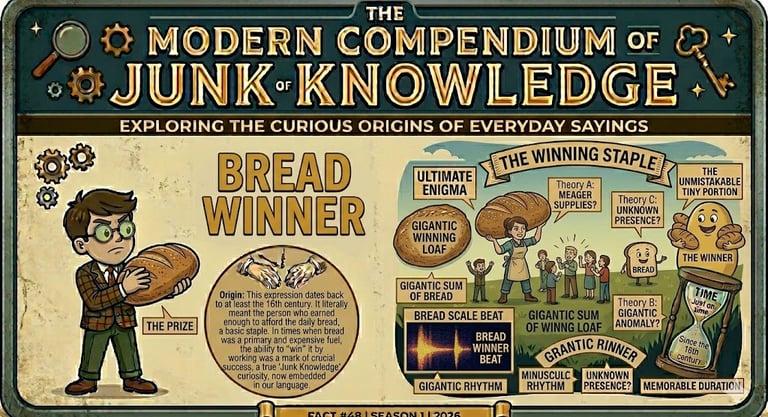
A breadwinner is the primary or sole earner of a household, whose wages provide the essential financial support for themselves and their dependents. While it is now a standard economic term for the person who provides the means for survival, its history is deeply tied to the shifting social structures of the industrial age.
The Deep Dive
The term is a compound of "bread" (representing basic sustenance) and "winner" (referring to an earner), and its evolution tracks the seismic shifts of Western labor history.
Etymological Roots: While "bread" has been used as a synonym for "livelihood" since the early 1700's, the specific term "breadwinner" didn't gain traction until the early 19th century (roughly 1818–1821). It combines the concept of bread as the most fundamental unit of survival with "win" in its archaic sense: to struggle, to toil, or to work at something.
The "Lord" Connection: The word shares a surprising linguistic ancestor with the word "lord." "Lord" comes from the Old English hlaford, which literally translates to "the guardian of the loaves" (hlaf = bread, weard = guardian). In the feudal system, the lord was the ultimate provider and protector for his entire estate.
The Industrial Pivot: Before the mid-19th century, most families operated as a single, collective economic unit; men, women, and children often contributed to a diverse range of income streams, such as spinning, farming, or small crafts. As industrialization moved work into factories, the "breadwinner model" was born. This was the revolutionary idea that a single person's individual wage—traditionally the father's—should be high enough to support an entire family, allowing others to exit the workforce.
The Moral Dimension: By the late Victorian era, the term had taken on a significant moral weight. A "good" breadwinner was seen as a pillar of stability and character. A father who squandered his wages or failed to provide was viewed as failing in his most fundamental social duty. Today, the term has evolved again as dual-income households become the standard, shifting the focus from a gendered role to a functional one.
Fast Facts
Slang Evolution: While "bread" has meant "livelihood" for centuries, it didn't become common slang for "money" until the mid-20th century, particularly within jazz and beatnik cultures.
Global Equivalents: The term has literal parallels in other Germanic languages, such as the Dutch broodwinning and West Frisian breawinning, both of which describe the act of earning one's living.
References
Griffin, E. (2020). Bread Winner: An Intimate History of the Victorian Economy. Yale University Press.
Oxford English Dictionary. (2026). The Etymology of Industrial Subsistence and Wage Structures.
Ammer, C. (2013). The Dictionary of Clichés. Skyhorse Publishing.