Break a Leg
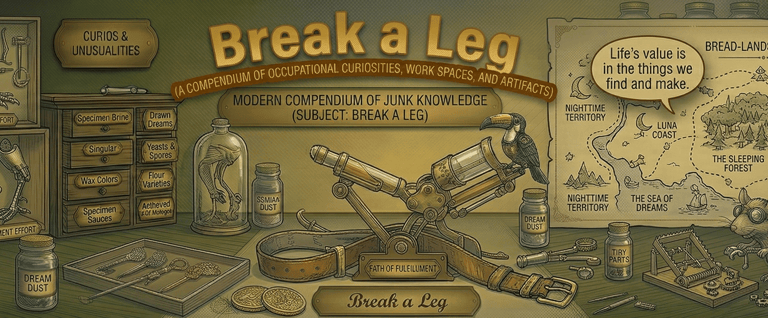
The Definition
A way to wish a performer good luck before they go on stage. It is an "anti-superstition" where saying the opposite of what you want is believed to prevent bad luck from interfering with a performance.
The Deep Dive
This is perhaps the most famous piece of "junk knowledge" in the arts, with theories ranging from the literal physical strain of a bow to the ghostly interference of theater spirits.
The "Leg" of the Stage: The most technical theory refers to the "legs" of the theater—the long, narrow black curtains (borders) that hang on the sides of the stage to mask the wings from the audience. In the days of Vaudeville, a performer only got paid if they actually appeared on stage. To "break a leg" meant to pass through the line of the curtains and enter the performance area, thereby guaranteeing a paycheck.
The "Curtsy" Snap: Another popular theory points to the physical act of bowing. A "break" was a 16th-century term for a deep, theatrical bow or curtsy where the performer would bend their knee so sharply that they were "breaking" the straight line of their leg. To "break a leg" was a wish for a performance so successful that the actor would be forced to take multiple, bone-bending bows.
The German "Hals- und Beinbruch": Some linguists trace it back to a World War I-era German phrase, Hals- und Beinbruch (break your neck and leg). It was likely a "corrupted" version of a Hebrew blessing, Hatzlakha u-brakha (success and blessing). To the German ear, the Hebrew sounds similar to "neck and leg break," and the phrase was adopted as a bit of dark, protective irony.
The phrase didn't become a standard English theatrical greeting until the 1920's and 30's. Before then, actors (who are a notoriously superstitious bunch) believed that the "theatrical spirits" were spiteful and would grant you the exact opposite of whatever you wished for. By wishing for a broken bone, you were tricking the universe into granting a flawless show.
Fast Facts
The John Wilkes Booth Myth: A common "junk" theory claims it refers to Booth breaking his leg after jumping onto the stage after assassinating Lincoln. However, there is no evidence that actors used the phrase for decades after 1865.
The "Macbeth" Rule: "Break a leg" is a safe alternative to saying "Good luck," but never say "The Scottish Play" (Macbeth) inside a theater, or you'll be forced to exit, spin around three times, and spit over your shoulder to cleanse the curse.
Global Variations: In the world of opera and ballet, the preferred "bad luck" wish is often the Italian In bocca al lupo (In the mouth of the wolf), to which the performer responds, Crepi! (May it die!).
References
Ammer, C. (2013). The Dictionary of Clichés. Skyhorse Publishing.
Urdang, L. (1988). The Whole Ball of Wax: And Other Colloquialisms. Perigee Books.
The Oxford English Dictionary. (2026). Break (v.) and Leg (n.). Oxford University Press.
Grose, F. (1785). A Classical Dictionary of the Vulgar Tongue. (Early entries on theatrical slang).