Busman's Holiday
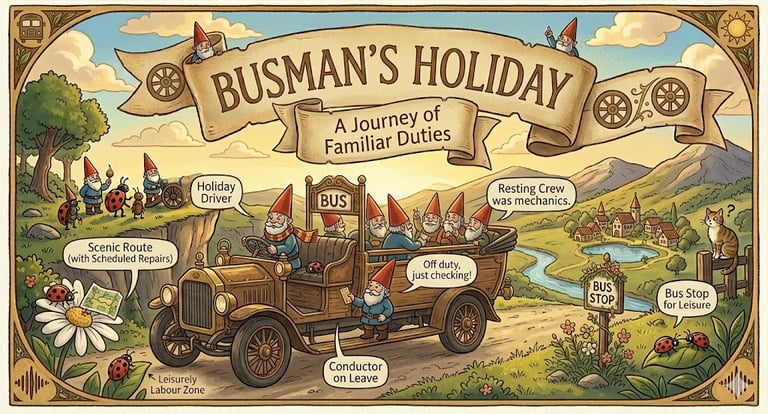
The Definition
A busman’s holiday is a vacation or day off spent doing the exact same activity that one does for their regular, daily occupation. It describes the ironic human tendency to engage in one’s professional craft for leisure, demonstrating how deeply a vocation can shape a person’s identity and habits.
The Deep Dive
The phrase is a literal artifact from the grueling logistics of public transit in late 19th-century London.
The Horse-Drawn Omnibus: In the 1890’s, London’s public transportation relied heavily on massive, horse-drawn omnibuses. The drivers of these vehicles—known colloquially as busmen—worked notoriously long, exhausting hours, navigating chaotic, cobblestone streets in all weather conditions. They developed a hyper-specific expertise in handling horses, managing tight schedules, and reading the moods of the city's commuters.
The Companionate Attachment: A driver didn't just operate a vehicle; they were intimately paired with a specific team of horses for months or years at a time. On their rare, mandated days off, a busman would often find themselves restless and disconnected from the rhythm of the city.
The Holiday Routine: To spend their holiday, a driver would frequently board an omnibus driven by a colleague. They would sit on the upper deck or stand near the driver’s platform, spending their leisure hours watching how their peer handled the horses, critiquing their driving style, and gossiping about the transit company's management. They were physically on vacation, but mentally, they were still entirely on the route.
Linguistic Saturation: The phrase first appeared in British print around 1893 to describe this specific transit subculture. By the early 20th century, it crossed the Atlantic and shed its literal connection to public transportation. It became the universal shorthand for any professional who cannot seem to leave their work behind—such as a chef who cooks an elaborate multi-course meal on their night off, or a professional driver who goes on a long cross-country road trip for relaxation.
Fast Facts
The Workaholic Variant: In modern organizational psychology, a busman's holiday is often studied as a form of "positive work reflection," where individuals engage in their professional skills during personal time because they derive genuine intrinsic joy from the craft, rather than feeling exploited by it.
Literary Fame: The phrase was cemented into the upper echelons of pop culture by Dorothy L. Sayers’s famous 1937 detective novel, Busman’s Honeymoon, where her aristocratic sleuth, Lord Peter Wimsey, attempts to go on a peaceful honeymoon only to immediately stumble upon a murder mystery that forces him back to work.
References
Green, J. (2010). Green's Dictionary of Slang. Chambers Harrap.
Ammer, C. (2013). The Dictionary of Clichés. Skyhorse Publishing.
Oxford English Dictionary. (2026). The Sociology of Late Victorian Urban Transit and Occupational Jargon.