Butt Load
The Definition
In modern, casual slang, a "butt-load" is used as a humorous, slightly vulgar hyperbole to describe an immensely large, unquantifiable amount of something—such as "a buttload of paperwork" or "a buttload of money." However, historically and logistically, a butt is not an anatomical reference at all; it is a highly specific, legally defined unit of liquid measurement used for centuries in commerce and wine-making.
The Deep Dive
The phrase is a spectacular example of linguistic corruption, where a completely legitimate piece of medieval shipping infrastructure was re-interpreted by modern speakers through the lens of body humor.
The Anatomy of the Cask: To trace the phrase, you have to look at the traditional wooden barrels used to transport liquids before the invention of steel shipping containers. In the British imperial system of weights and measures, wooden casks weren't just random containers; they were manufactured to strict, standard volumetric sizes. The king of these heavy transport casks was the butt.
The Mathematical Measurement: Derived from the Latin buttis (meaning a wine vessel) and the Old French boute, a standard butt was a massive wooden cask designed specifically to carry wine, sherry, or beer. By statutory law, a single butt was equal to exactly:
2 Hogsheads
126 US Gallons (approximately 477 liters)
1,050 Pounds of liquid weight
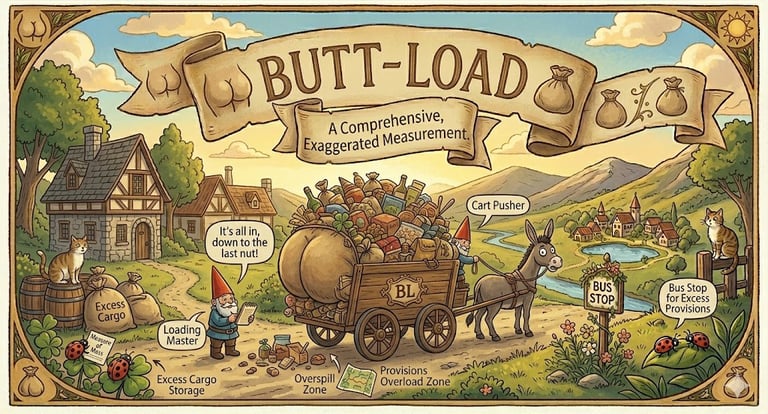
The Teamster's Capacity: A literal "butt-load" was the maximum amount of heavy cargo a standard horse-drawn cart or small river barge could physically transport at one time. Because a filled wooden butt weighed over half a ton, loading more than one or two of these massive casks onto a wagon would snap the axle or collapse the floorboards. Therefore, when a medieval merchant or a dockworker saw a cart arriving at a warehouse carrying a full butt of wine, they would declare it a full butt-load—the absolute maximum legal capacity of transport.
The Slang Migration: As the old imperial cask sizes were phased out of modern shipping by standard metal drums and trucks, the literal meaning of the word faded from memory. When 20th-century American speakers encountered the phrase in old shipping logs or regional dialects, they naturally decoupled the word "butt" from the wooden barrel and pinned it onto the common anatomical slang term for the human backside. The phrase instantly transformed from a precise volumetric measurement into a crude, highly evocative piece of playground hyperbole, implying an amount of material so large it would overwhelm a person's capacity to handle it.
Fast Facts
The "Butt" of the Joke: The exact same linguistic root gave us the phrase "to be the butt of a joke." In that context, it refers to an archival archery target or a mound of turf (the butt) that soldiers used for shooting practice, meaning the individual has become the static target for everyone else's arrows or mockery.
The "Hogshead" Cousin: Much like the butt, the hogshead is another completely real, historical 63-gallon liquid measurement that modern ears frequently mistake for an eccentric piece of animal-based slang, demonstrating how deeply our language relies on the ghost-vocabulary of early commerce.
References
Smyth, W. H. (1867). The Sailor's Word-Book: An Alphabetical Digest of Nautical Terms. Blackie and Son. (Documenting the standard capacities of shipboard victualling casks).
Ammer, C. (2013). The Dictionary of Clichés. Skyhorse Publishing.
Oxford English Dictionary. (2026). The Metaphorical Degeneration of Medieval Statutory Volumetric Nomenclature and Cooperage Standards into Contemporary Low-Register Vernacular.