Butter Someone Up
The Definition
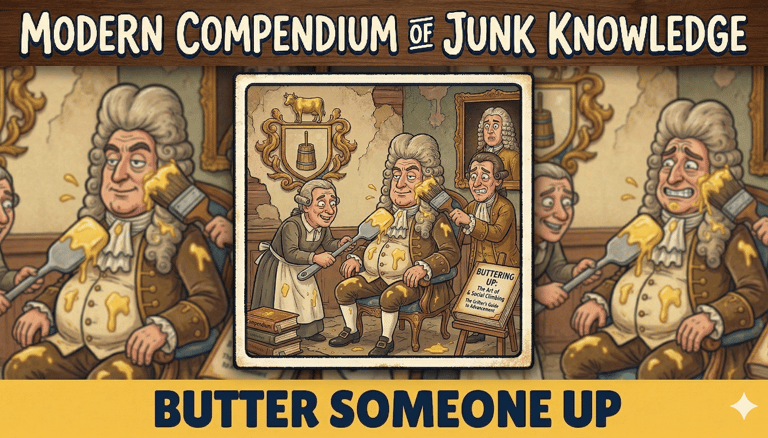
To praise or flatter someone excessively, usually with the intention of gaining a favor, a promotion, or a specific advantage. It describes the act of "smoothing over" a person’s ego to make them more pliable and receptive.
The Deep Dive
This is a literal piece of "junk knowledge" from the religious and social traditions of Ancient India. While we now use it to describe a student complimenting a teacher or an employee praising a boss, the origin is a sacred, physical act involving ghee (clarified butter).
In traditional Hindu worship (puja), it was common practice for devotees to create or visit statues of their deities. To seek a favor from a god—whether for a good harvest, a healthy child, or protection in battle—the devotee would take handfuls of clarified butter and literally smear or "toss" them onto the statue.
The Smeared Statue: The more butter applied to the deity, the more "pleased" the god was believed to be. The butter made the stone figure shine and appear "well-fed" and honored.
The "Slippery" Ego: The metaphor suggests that by "buttering" the person in power, you are making them "slick" and "smooth," removing the friction of their resistance and making them more likely to "slide" into agreement with your request.
The phrase entered the English language in the mid-1700's, likely brought back by British colonial officials and traders who observed these customs in India. By the Victorian era, it had lost its religious connotations and became a standard term for social manipulation through "oily" praise.
Fast Facts
The "Oily" Link: This is a direct linguistic cousin to being "oily-tongued" or an "oily" character, both of which refer to the slippery, untrustworthy nature of someone who uses too much flattery.
The Tibetan Version: In Tibet, "butter sculptures" are a massive part of New Year celebrations. Monks spend months carving intricate scenes out of yak butter to "butter up" the spirits for a prosperous year.
The First Print: While the custom is ancient, the specific English idiom "to butter up" didn't gain widespread popularity in literature until the early 19th century.
References
Dubois, J. A. (1817). Description of the Character, Manners, and Customs of the People of India.
Ammer, C. (2013). The Dictionary of Clichés. Skyhorse Publishing.
Grose, F. (1811 edition). Dictionary of the Vulgar Tongue.
The Oxford English Dictionary. (2026). Butter (v.). Oxford University Press.