Buy the Farm
The Definition
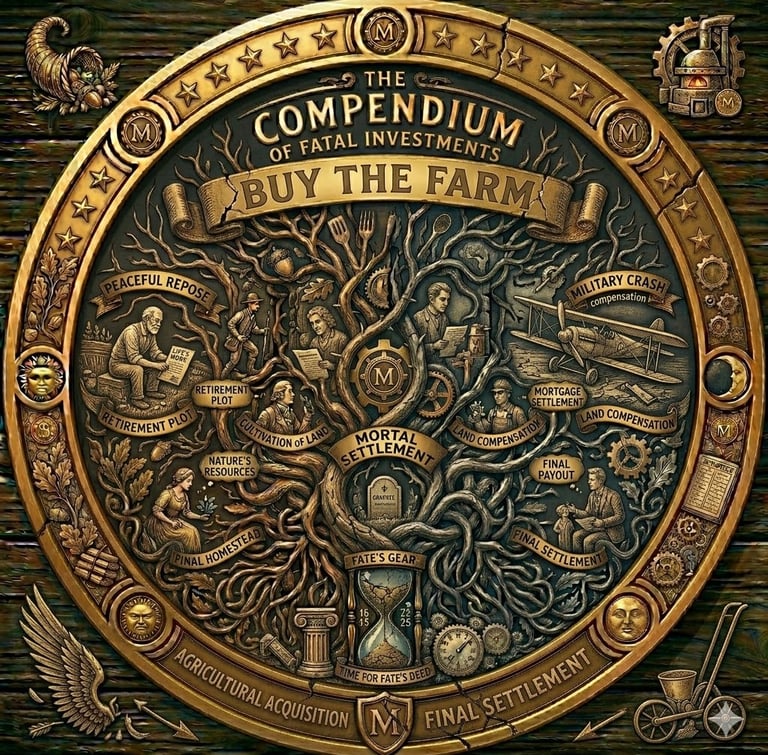
A fatalistic and somewhat irreverent idiom used as a euphemism for dying, particularly in a sudden or violent manner (such as a crash or in combat). It is the final "what's done is done" of a human life—the moment a person "steps into their boots" for the very last time.
The Deep Dive
The "junk knowledge" behind "buy the farm" is that it isn't about a peaceful retirement to the countryside; it’s about the financial debris of a military tragedy. While the phrase gained massive popularity during World War II, its roots are a mix of pilot gallows humor and the cold reality of insurance claims.
The Crash Site Theory: In the early days of aviation, a pilot who crashed into a farmer's field literally "bought" the farm—or rather, the government was forced to pay for it. The payout from the military’s liability insurance or the pilot’s own life insurance was often just enough to pay off the farmer's mortgage (or the "load" of debt on the pilot's family home). To "buy the farm" was a grim joke: the pilot paid for the land with their life.
The "Final Acre" Metaphor: Another layer of "junk" lore suggests that every man’s goal was to eventually stop working and buy a small farm to live out his days. If a soldier died in battle, he was said to have "bought the farm" early—attaining his final "six feet under" plot of land without ever getting to enjoy the "home fires burning."
The 1950's Solidification: While the sentiment existed in the 1920's, the specific phrasing "bought the farm" peaked in the mid-1950's among Jet Age test pilots. It was a way to "pipe down" the terror of high-speed flight by framing death as a simple real estate transaction.
The phrase reached peak "junk" status in the world of cinema and military novels. It represents the "junk" of mortality: the attempt to use a business metaphor (a purchase) to make sense of the absolute and "axe-like" finality of death.
Fast Facts
The "Kick the Bucket" Rival: While both mean to die, "kick the bucket" is more domestic and implies a struggle, whereas "buy the farm" is more technical and associated with professional risk.
The "Acre" Connection: In British English, a similar phrase was "buying the plot," referring to the cemetery plot. The American version replaced the "plot" with the "farm," reflecting the 19th-century agrarian dream.
The Insurance Reality: During WWII, the U.S. government provided $10,000 in life insurance to servicemen. In the 1940's, $10,000 was often the exact price of a small family farm, making the "buy the farm" metaphor a literal financial truth for many grieving "kith and kin."
References
Lighter, J. E. (1994). Historical Dictionary of American Slang.
Ammer, C. (2013). The Dictionary of Clichés. Skyhorse Publishing.
Wolfe, T. (1979). The Right Stuff. (Discussing pilot-gallows humor).