Buying a Pig in a Poke
The Definition
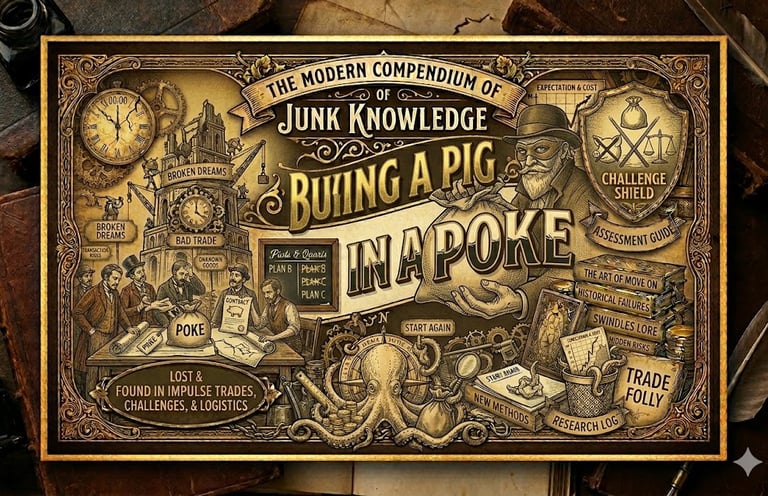
To "buy a pig in a poke" is to purchase something without seeing or inspecting it first. It is the ultimate warning of caveat emptor (let the buyer beware), describing a "blind bargain" where the buyer risks receiving something of much lower value than promised.
The Deep Dive
This idiom is a survivor from the Middle Ages, appearing in English literature as far back as the 13th century.
The Etymological "Poke": The word "poke" is an archaic term for a sack or bag, derived from the French poque. If that sounds familiar, it's because the diminutive form—a small bag—gave us the word "pocket." In medieval marketplaces, a "poke" was the standard way to transport a suckling pig.
The Marketplace Swindle: The phrase refers to a specific confidence trick. A seller would claim to have a prime piglet inside a tied sack. If the buyer was gullible enough to pay without looking inside, they might get home only to find a cat, a dog, or a rabbit—animals that were much less valuable for meat than a pig. This is where the phrase's cousin, [Let the Cat Out of the Bag], finds its disputed origin; the secret was revealed only when the "poke" was finally opened.
A Global Warning: This concept is so universal that almost every European language has its own version, though most skip the pig and go straight to the deception. In German (die Katze im Sack kaufen) and French (acheter chat en poche), the literal translation is "to buy a cat in a sack."
Fast Facts
The "Sold a Pup" Equivalent: In British English, a similar scam involves being "sold a pup"—buying something that looks promising but turns out to be worthless or troublesome.
Ancient Advice: One of the earliest recorded versions comes from the 1275 poem The Proverbs of Hendyng, which wisely advised: "When a man gives thee a pig, open the pouch."
References
Heywood, J. (1546). A Dialogue Conteinyng the Nomber in Effect of All the Prouerbes in the Englishe Tongue.
Ammer, C. (2013). The Dictionary of Clichés. Skyhorse Publishing.
Oxford English Dictionary. (2026). The Evolution of Medieval Market Slang.