Can of Worms
The Definition
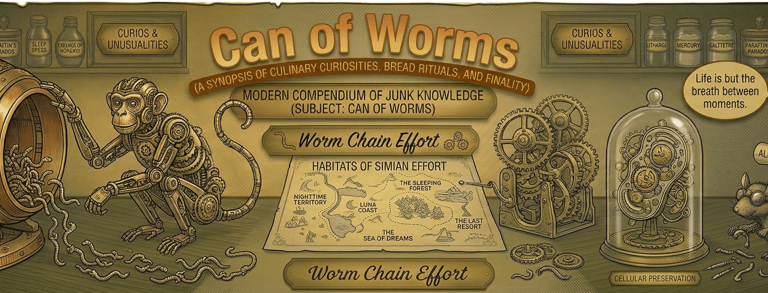
A complex, troublesome, or unpleasant situation that becomes even worse once you attempt to solve it. To "open a can of worms" is to accidentally trigger a cascade of unforeseen problems that are nearly impossible to "put back" or contain.
The Deep Dive
This is a "high-wriggle" piece of junk knowledge from the mid-20th-century American fishing industry. While we now use it for legal disputes or messy family secrets, the origin is a literal, physical nightmare for any disorganized fisherman.
The Bait Shop: In the early 1900's, live bait (specifically earthworms or "night crawlers") was sold in simple, unsealed tin cans. These cans were often repurposed from soup or tobacco.
The "Escape" Factor: Worms are masters of finding the smallest gap. If a fisherman left the lid slightly ajar or the can sat in the sun too long, the worms would begin to "boil" over the top.
The "Tangle": Because worms are translucent and slimy, they naturally intertwine into a dense, pulsating ball to stay moist. Once you "open" the situation, you aren't just dealing with one worm; you are dealing with a mass of individuals that are physically knotted together.
The Containment Failure: The "junk" reality of the metaphor is the impossibility of reversal. Once the worms have spilled out into the bottom of a boat or a tackle box, trying to pick them all up and stuff them back into a small tin container is a frustrating, slippery, and ultimately failing task.
The phrase "opening a can of worms" was a well-established bit of "boathouse slang" by the 1920's. It didn't make the jump into general American business and political speech until the 1950's, where it became the preferred way to describe a "Pandora’s Box" of bureaucratic or social issues.
Fast Facts
The "Pandora" Link: This is the ancient Greek ancestor of the phrase. While Pandora opened a "jar" (mistranslated as a box) that released all the evils of the world, the "can of worms" is its more modern, blue-collar equivalent.
The "Worm" Verb: In the 17th century, "to worm something” meant to extract information slowly and insidiously, a precursor to the "messy" discovery implied by the modern idiom.
The First Print: One of the earliest recorded figurative uses appeared in a 1951 newspaper, describing a complicated legislative debate as "opening a real can of worms."
References
Bergman, R. (1938). Just Fishing. (On the maintenance of live bait).
Ammer, C. (2013). The Dictionary of Clichés. Skyhorse Publishing.
Safire, W. (2008). Safire's Political Dictionary. Oxford University Press.
The Oxford English Dictionary. (2026). Worm (n.1). Oxford University Press.